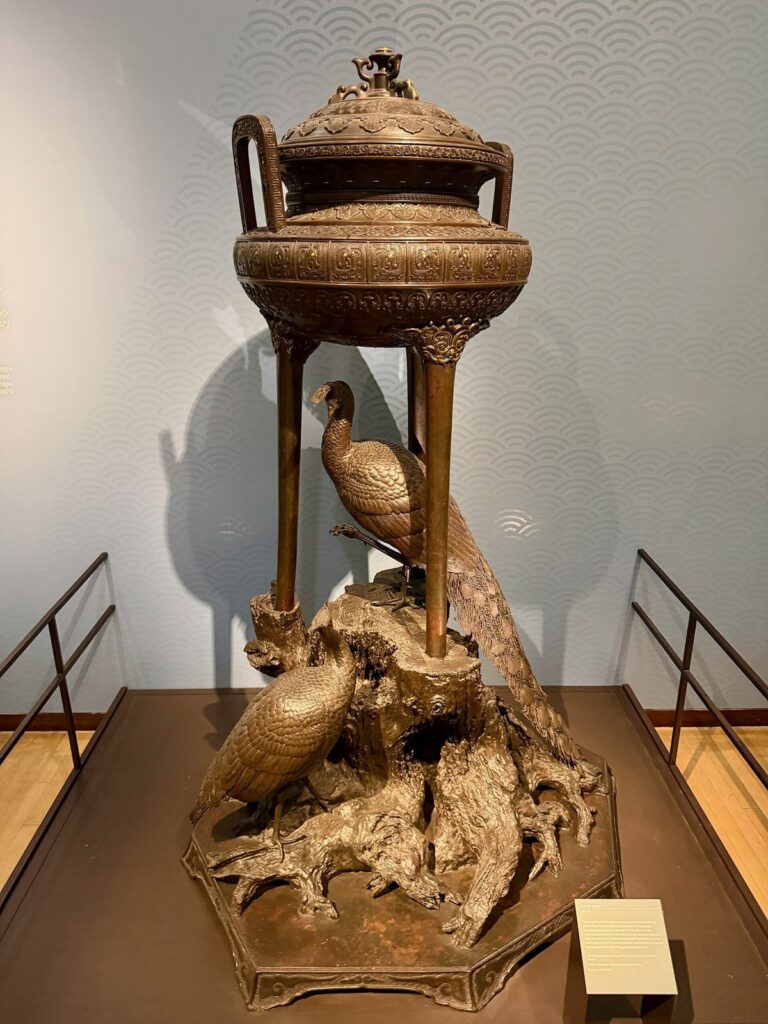
Reference · Victoria and Albert Museum Suzuki Chōkichi, Incense burner with peacock and peahen, c. 1877–78, Victoria and Albert Museum (photograph by Oleg Yunakov). CC BY-SA 4.0. Source ↗
I · Maker & date
Maker: Suzuki Chōkichi (Kakō) (1848–1919)
Date: c. 1877–78
Collection: Victoria and Albert Museum 188:1 to 9-1883
II · Technique
Cast and patinated bronze, cast in several pieces: the bowl, the upper burner, the lid with its knob, and a base cast in sections. A tree stump with a peacock and peahen.
III · Exhibition & provenance
Displayed on the Kiryū Kōshō Kaisha stand at the Paris Exposition Universelle, 1878. Bought by Siegfried Bing and purchased from him by the V&A, accessioned 1883.
IV · Marks
Signed under the bowl Dai Nihon Kakō sei, “Great Japan, made by Kakō”, per the V&A.
Sources: V&A Explore the Collections, 188:1 to 9-1883 ↗ · Wikimedia Commons file (CC BY-SA 4.0, Oleg Yunakov) ↗ · 鈴木長吉, Japanese Wikipedia ↗
Assessment
See how we score
| Criterion | Score |
|---|---|
| Maker stature | 2.5 / 2.5 |
| Recognition (museum / designation / price) | 3 / 3 |
| Exhibition | 1 / 1 |
| Technique (cited) | 1.5 / 1.5 |
| Provenance | 1 / 1 |
| Condition, scale & documentation | 1 / 1 |
| Total | 10 / 10 |
Reasoning: Imperial Household Artist (1896); V&A, purchased 1883 with special Treasury permission; shown at Paris 1878; signed; monumental scale. How we score.
Maker context
Suzuki Chōkichi, whose art name was Kakō, was born on 12 September 1848 at Ishii in Musashi Province, in present-day Sakado, Saitama. He studied wax-model casting for five years with Okano Tōryūsai and set up on his own in Edo at eighteen.
In 1874 he became supervisor of the casting department of the Kiryū Kōshō Kaisha, the government-backed company set up to export Japanese crafts, and later its head of works. He left the company in 1882. During those years he made large works for exhibitions at home and abroad. The V&A’s bronze incense burner with a peacock and peahen, 228.6 cm high and signed Dai Nihon Kakō sei, was shown on the company’s stand at the Paris Exposition Universelle of 1878. It was bought from Siegfried Bing and registered by the museum in 1883.123
Summarised from our maker page, where every fact is footnoted: Suzuki Chōkichi 鈴木長吉.
The V&A record states that the burner was cast in several pieces and modelled as a tree stump with a peacock and peahen, that the stump may have been cast from real wood, and that the museum paid Siegfried Bing £1,586 7s. 2d. for it, with special permission from the Treasury.4
Notes to “Maker context”
Related records

Descriptions record our research and opinion as of 20 October 2026. Works are offered as described. Please see our Terms of Sale.