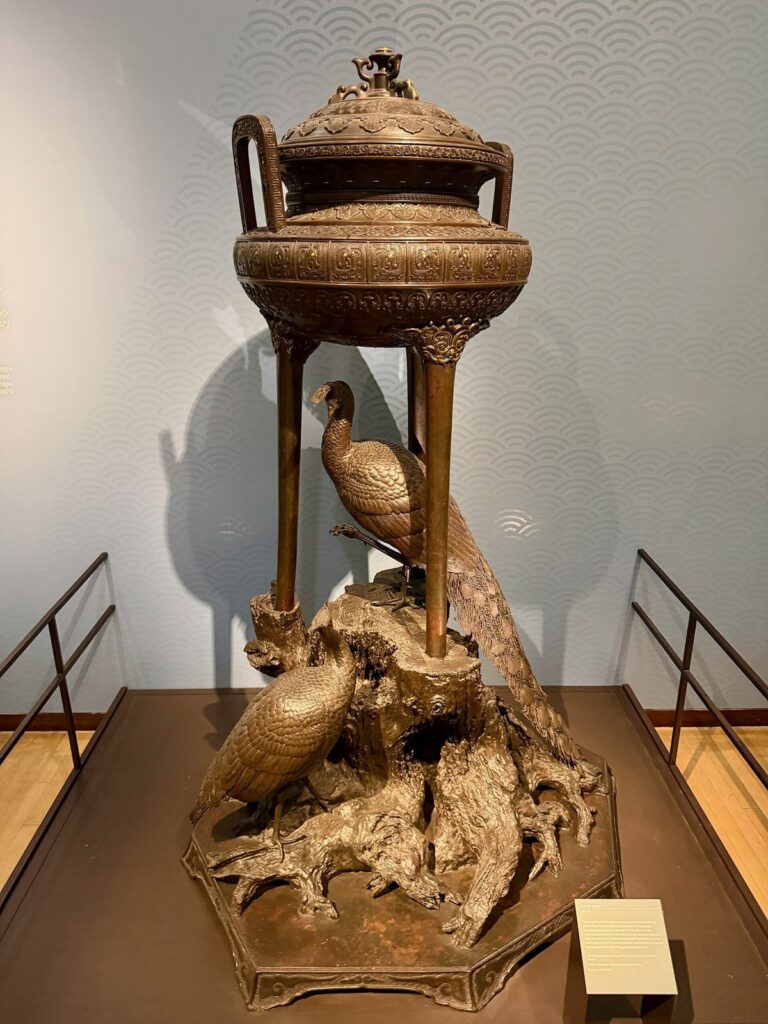
Reference Suzuki Chōkichi, Incense burner with peacock and peahen, c. 1877–78, Victoria and Albert Museum (photograph by Oleg Yunakov). CC BY-SA 4.0. Source ↗

Biography
Suzuki Chōkichi, whose art name was Kakō, was born on 12 September 1848 at Ishii in Musashi Province, in present-day Sakado, Saitama. He studied wax-model casting for five years with Okano Tōryūsai and set up on his own in Edo at eighteen.14
In 1874 he became supervisor of the casting department of the Kiryū Kōshō Kaisha, the government-backed company set up to export Japanese crafts, and later its head of works. He left the company in 1882. During those years he made large works for exhibitions at home and abroad. The V&A’s bronze incense burner with a peacock and peahen, 228.6 cm high and signed Dai Nihon Kakō sei, was shown on the company’s stand at the Paris Exposition Universelle of 1878. It was bought from Siegfried Bing and registered by the museum in 1883.12
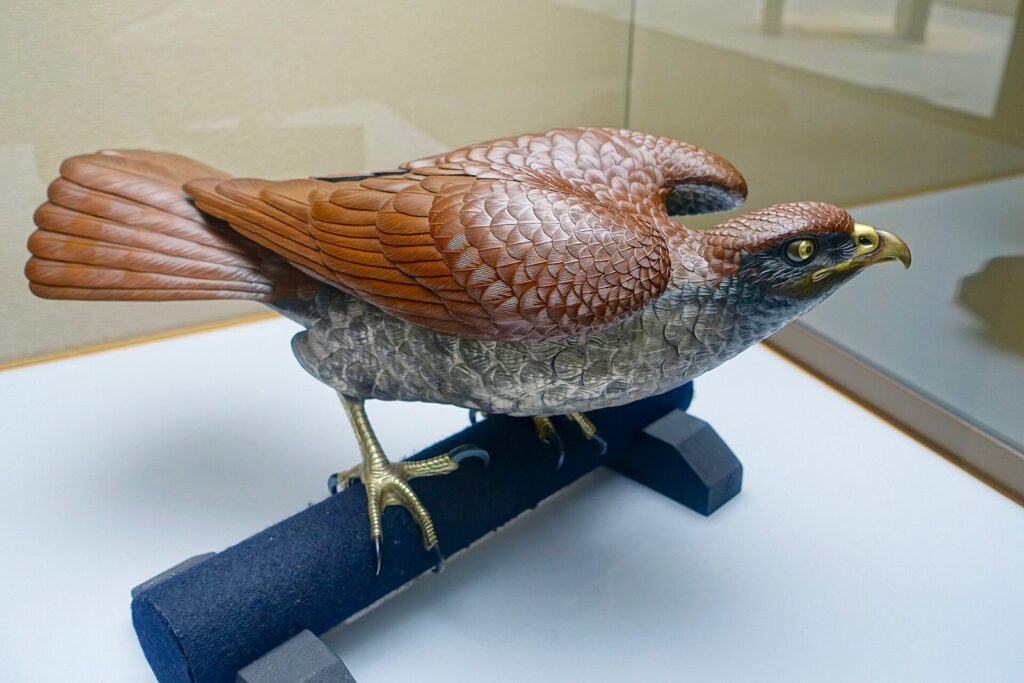
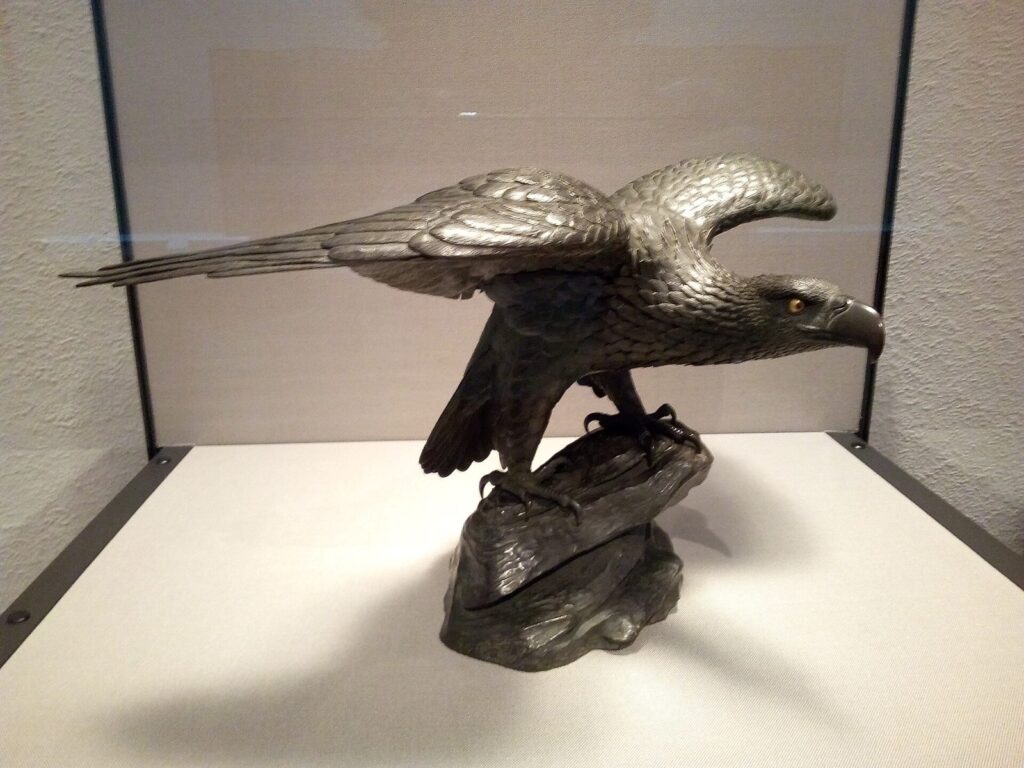
His Twelve Hawks, made under the direction of Hayashi Tadamasa, and his eagle okimono, now in the Tokyo National Museum, were both shown at Chicago in 1893. A bronze eagle won a gold medal at the Nuremberg metalwork exhibition of 1885. He was appointed an Imperial Household Artist on 30 June 1896.13
Japanese Wikipedia records that in later years his highly detailed style fell out of step with taste. He left the field, adopted an heir and moved into the abrasives trade, and he died in Tokyo on 29 January 1919. Little is known of his last years.1
Other recorded works include a lantern of 1880 at Yasukuni Shrine, presented by the Metropolitan Police; a pair of silver vases of 1894, presented to the Emperor and Empress on their silver wedding anniversary and now in the Museum of the Imperial Collections; and a silver stand made in 1900–03 for a crystal ball in the Museum of Fine Arts, Boston. The Boston stand is signed with his title as Imperial Household Artist and the art name Kakō (嘉幸).1
Chronology 年譜
| Date | Event | Source |
|---|---|---|
| 1848 | Born 12 September, Musashi Province. | 1 |
| 1874 | Casting supervisor, Kiryū Kōshō Kaisha. | 1 |
| 1877–78 | Peacock incense burner made; shown at Paris in 1878. | 2 |
| 1882 | Leaves the Kiryū Kōshō Kaisha. | 1 |
| 1883 | The V&A registers the incense burner. | 2 |
| 1880 | Lantern for Yasukuni Shrine. | 1 |
| 1885 | Gold medal for a bronze eagle, Nuremberg. | 1 |
| 1893 | Twelve Hawks and Eagle shown at Chicago. | 1 |
| 1894 | Silver vases for the Imperial silver wedding. | 1 |
| 1896 | Appointed Imperial Household Artist (30 June). | 3 |
| 1919 | Dies 29 January, Tokyo. | 1 |
Archive records
The V&A incense burner 孔雀香炉
The V&A’s record adds detail on how the incense burner was made and bought. It was cast in several pieces: the bowl with handles (itself cast in sections), the upper part, the lid with a separately cast knob, and the base, also in sections. It is modelled as a tree stump and roots with a peacock and a peahen standing on it. The museum suggests that the stump may have been cast from a real piece of wood, a process known among other nineteenth-century Japanese metalworkers, and that the realism of the birds suggests work from live models. For some later work, it says, Chōkichi kept live birds in his studio.1
The signature under the bowl reads Dai Nihon Kakō sei, “Great Japan, made by Kakō”. Siegfried Bing, the Parisian dealer, offered the piece to the museum. The V&A paid him £1,586 7s. 2d., a sum that, according to the record, needed special permission from the Treasury.1
The Metropolitan Museum of Art also holds an iron eagle with outstretched wings by Suzuki Chōkichi, of the late nineteenth century, in iron, pigment, shakudō, shibuichi and wood, given by James R. Steers in 1911. The Met does not release that photograph as open access, so it is not shown here.2


Notes to “The V&A incense burner”
Public auction results
Public auction results, cited to the auction house record, including buyer’s premium unless stated, in the original currency. They are historical facts, not a valuation of any work offered.
No public auction results for this maker are recorded in our index yet.
Sources
Descriptions record our research and opinion as of 20 October 2026. Works are offered as described. Please see our Terms of Sale.