Knowledge · Glossary 用語集
107 terms
Romanisation, kanji and a short English definition for each term, with its source. Most definitions are quoted from JAANUS, the Japanese Architecture and Art Net Users System, whose romanisation (for example shippou for shippō) we keep as published.
| Romaji | Kanji | English | Source |
|---|---|---|---|
| asa-no-ha | 麻の葉 | A repeating six-sided geometric design that resembles the leaves of the hemp plant, asa 麻. | JAANUS ↗ |
| awataguchiyaki | 粟田口焼 | Awataguchi 粟田口 kiln. Also called awatayaki 粟田焼. A ceramic ware that was made in Awataguchi, at the foot of Higashiyama 東山 in Kyoto. | JAANUS ↗ |
| bijinga | 美人画 | Lit. pictures of beautiful women. Pictures depicting the beauty of the appearance, manners, and customs of women. | JAANUS ↗ |
| bizenyaki | 備前焼 | Bizen 備前 ware. Pottery made in Inbe 伊部 village of Bizen province, modern Wakegun 和気郡 of Okayama prefecture. | JAANUS ↗ |
| bunjinga | 文人画 | Lit. literati painting. Ch: wenrenhua. A type of painting in China, Korea, and Japan. | JAANUS ↗ |
| butsuzou | 仏像 | A general term which refers to all images of the Buddha used as objects of worship, although most commonly used to refer to Buddhist statues. | JAANUS ↗ |
| byoubu | 屏風 | A folding screen consisting of multiple, joined panels. Folding screens vary in size; the standard size consists of six panels approximately 1.5m high and 3.5m wide. | JAANUS ↗ |
| chaire | 茶入 | A tea caddy, usually ceramic, used to hold strong tea at a tea ceremony. | JAANUS ↗ |
| chanoyu | 茶湯 | , architecture / tea houses Lit. the hot water for tea. Also known as sadou 茶道 or chadou . | JAANUS ↗ |
| chawan | 茶碗 | Also written 茶盗. 1 A generic term for ceramic wares called toujiki 陶磁器 from the 9 – 16c. | JAANUS ↗ |
| chinkin | 沈金 | Also called chinkinbori 沈金彫. A technique developed in aizunuri 会津塗 that involves cutting a design into a lacquered surface, applying a thin layer of lacquer into the incised lines, then applying gold foil, gold dust or colored dust over the soft lacquer to form a contrast with the ground. | JAANUS ↗ |
| choukin | 彫金 | Chasing. Carving patterns or letters with a chisel on metal work. A common technique is nanako-uchi 魚々子打 (fish-roe engraving) in which fine granulation is produced with a round-headed chisel. | JAANUS ↗ |
| chuukin | 鋳金 | Metal casting. A technique used in metalwork to produce vessels or sculptures by melting down metal and pouring it into a mould. | JAANUS ↗ |
| emaki | 絵巻 | Also called emakimono 絵巻物, or less commonly ekotoba 絵詞. Painting format of several genres where a long painting e 絵 or series of paintings illustrates a narrative; done on paper or silk, wound maki 巻 into a scroll, makimono 巻物 or kansubon 巻子本 around a roller jiku 軸 of ivory or wood. | JAANUS ↗ |
| fusuma | 襖 | An abbreviation for fusumashouji 襖障子, an opaque sliding screen, as distinguished from the translucent screen akarishouji 明障子. | JAANUS ↗ |
| fuuzokuga | 風俗画 | Paintings with the daily activities and special pleasures of contemporary life as their subject matter. | JAANUS ↗ |
| gofun | 胡粉 | A white pigment ganryou 顔料, used in Japan from the Muromachi period to the present day. | JAANUS ↗ |
| gunjou | 群青 | Also iwagunjou 岩群青. A blue pigment made from pulverized azurite, randoukou 藍銅鉱 or lapis lazuri, seikinseki 青金石; the most important blue pigment used in traditional Japanese painting nihonga 日本画. | JAANUS ↗ |
| hagiyaki | 萩焼 | Hagi ware. A general name for pottery made in the Matsumoto 松本 area of western Hagi City and in Nagato Fukawa 長門深川 in present-day Yamaguchi prefecture The kilns were sponsored by Mouri Terumoto 毛利輝元(1553-1625) who brought the Korean potter brothers Yi Kyong (Jp: Li Kei 李敬) and Yi Chak-kwang (Jp: Li… | JAANUS ↗ |
| Haitōrei | 廃刀令 | Sword Abolishment Edict. The edict of 28 March 1876 prohibiting most people from carrying swords in public. | Haitō Edict ↗ |
| haku | 箔 | Lit. foil or leaf. Gold, silver, copper, tin or brass pounded into a thin flat sheet and used for the decoration of art works and craft objects. | JAANUS ↗ |
| hakubyou | 白描 | Although the term literally means white drawing, hakubyou 白描 is a technique of painting that relies primarily on the use of brushline in monochromatic ink to define form, express movement and capture the essence of the object portrayed. | JAANUS ↗ |
| hakuoshi | 箔押 | Also hakuire 箔入れ, hakuoki 箔置き. Making a design by stitching gold, silver, or colored foil with glue onto ceramics, cloth or paper, or applying gold or silver foil to the lacquered surface of a statue. | JAANUS ↗ |
| heidatsu | 平脱 | Ch. Pingtuo. A technique in which thin sheets of metal are cut into decorative shapes and set in a lacquer base; the metal is revealed when further coats of lacquer are polished with charcoal or scraped away. | JAANUS ↗ |
| houou | 鳳凰 | A phoenix. A mythical Chinese bird, thought to have been introduced to Japan in the Asuka period. | JAANUS ↗ |
| iki | いき | The aesthetic ideal of the Edo merchant class during the late 18c and 19c, combining material sensuality and elegant sophistication. | JAANUS ↗ |
| imariyaki | 伊万里焼 | Imari ware. A general term for porcelain from the Arita 有田 region of Saga prefecture, but not including the Kakiemon 柿右衛門 and Nabeshima 鍋島 kilns. | JAANUS ↗ |
| inrou | 印籠 | Lit. seal caddy. A tiered rectangular or circular container used originally for seals but later for medicines and other small objects: Edo period inrou are held together by a cord and closed with a bead, ojime 緒締, the cord runs through a toggle netsuke 根付, which suspends it from the sash, obi 帯. | JAANUS ↗ |
| inshou | 印章 | A seal stamp carved with characters or pictographs which serves as proof or certification when pressed on a vessel, utensil, painting, document or letter. | JAANUS ↗ |
| kachouga | 花鳥画 | Lit. bird-and-flower painting. Paintings of birds and flowers, flowers only kakiga 花卉画, insects, plants souchuuga 草虫画, or domestic animals reimouga れい毛画. | JAANUS ↗ |
| kakemono | 掛物 | Also called by names such as kakejiku 掛軸, kakefuku 掛幅, jikumono 軸物, jiku 軸, and fuku 幅. | JAANUS ↗ |
| kanagu | 金具 | Also kanamono 金物 (metal thing). Metal fittings that are not only functional but often decorative. | JAANUS ↗ |
| Kanouha | 狩野派 | A hereditary school of professional artists, patronized by military governments from the late Muromachi to the early Meiji periods. | JAANUS ↗ |
| kanshitsu | 乾漆 | Also kanshitsuzou 乾漆像, kanshitsu-zukuri 乾漆造. Dry lacquer technique. A technique used to produce Buddhist images brought from China in the late 7c and in Japan throughout the Nara period. | JAANUS ↗ |
| kaou | 花押 | Also kakihan 書判, lit. written seal mark, or han 判. Specifically designed character representing or accompanying the signature and affixed at the end of letters and documents okugaki 奥書. | JAANUS ↗ |
| karajishi | 唐獅子 | Ch: Tang Shizi. The Chinese lion. Representations of lions were produced by Chinese and then Japanese artists based on versions from India and Assyria that had been assimilated into Buddhist iconography. | JAANUS ↗ |
| karamono | 唐物 | Lit. Chinese things. The term is especially common in chanoyu 茶湯 to designate paintings, ceramics, lacquerware, textiles and other crafts, but has been used in a variety of contexts since the 8c. | JAANUS ↗ |
| karatsuyaki | 唐津焼 | Karatsu 唐津 wear. A general name for the glazed, high-fired pottery made at kilns producing Korean style pottery grouped around the port of Karatsu in Hizen 肥前 (Saga prefecture) from the Momoyama period. | JAANUS ↗ |
| katakiribori | 片切彫 | Single-sided chiselling. Engraving with an angled chisel edge; a speciality of Unno Shōmin. | 海野勝珉 ↗ |
| kebori | 毛彫 | Hairline engraving. A technique used in metalwork where a design was engraved on a surface in a sequence of fine lines, using a burin. | JAANUS ↗ |
| kinji | 金地 | Lit. gold ground. Generally refers to the gold background of a painting, regardless of whether the gold is applied as leaf haku 箔 or paint dei 泥. | JAANUS ↗ |
| kinran | 金襴 | Gold brocade. Woven of patterns with gold or silver woof on a plain ground of hiraori 平織 (plain fabric), ayaori 綾織 (twill) or shusu 繻子 (satin). | JAANUS ↗ |
| kinrande | 金襴手 | The Japanese name for the gold color added to Chinese wucai porcelain gosai 五彩, featuring a white-base with red, green and yellow motifs, made in Ming dynasty. | JAANUS ↗ |
| kirikane | 切金 | Also written 截金. Lit. cut-gold. 1 Metal foil haku 箔, generally gold or silver, cut into long, thin strips, or, triangular, square, and lozenge shapes systematically arranged to form lines or a decorative pattern on sculptures and paintings (see kirihaku 切箔). | JAANUS ↗ |
| kirin | 麒麟 | Ch: qilin. A mythical Chinese animal that combines the elemental male animal ki 麒 (Ch:qi) and the female rin 麟 (Ch:lin). | JAANUS ↗ |
| Kiryū Kōshō Kaisha | 起立工商会社 | Kiryū Kōshō Kaisha. A state-backed company founded in 1874 to make and export Japanese art and goods. | 起立工商会社 ↗ |
| kiyomizuyaki | 清水焼 | Kiyomizu ware. One of the terms commonly given to similar wares produced by several local kilns and associated with the old pottery market which still exists on the hill leading to Kyoto's Kiyomizudera 清水寺. | JAANUS ↗ |
| kougou | 香合 | Incense containers. Also called koubako 香箱. Small, lidded containers usually made of lacquer or ceramic, and sometimes wood, shell or metal, for storing the aromatic wood burned as incense. | JAANUS ↗ |
| kouro | 香炉 | Incense burner. Common materials are metal, pottery, horn, and lapis lazuli as well as various gems and woods. | JAANUS ↗ |
| kutaniyaki | 九谷焼 | Kutani ware. The term was used from around 1803, but only the original, ko-kutani 古九谷 (old Kutani) was actually made at the Kutani kiln in Kutani 九谷, Ishikawa prefecture. | JAANUS ↗ |
| kyouyaki | 京焼 | Kyoto ware. General name of the ceramic wares of Kyoto (except rakuyaki 楽焼), beginning in the Momoyama period and often decorated with polychrome enamels. | JAANUS ↗ |
| Kyō-Satsuma | 京薩摩 | Kyoto Satsuma. Satsuma-type earthenware painted in the Kyoto manner, made for export. | 錦光山宗兵衛 ↗ |
| makie | 蒔絵 | Lit. sprinkled picture. A technique which originated in the Heian period for lacquer ware decoration in which designs are made by scattering adhesive metal or color powder in soft lacquer or directly on wood. | JAANUS ↗ |
| miyabi | 雅 | Lit. Courtliness. The ideal of refined sensibility and courtly elegance associated with aristocratic society, particularly in the Heian period. | JAANUS ↗ |
| mizusashi | 水指 | Also mizutsubo 水壷. Lit. a water jar. A container of fresh water used either to fill the tea bowl chawan 茶碗, or the kettle chanoyugama 茶湯釜, in the tea ceremony. | JAANUS ↗ |
| mokuchou | 木彫 | Wooden sculpture. While wooden sculptures are relatively rare in India and China, wood has traditionally been the chief material used for sculpture in Japan. | JAANUS ↗ |
| mokume-gane | 木目金 | Wood-grain metal. A laminate of coloured metals worked to show a wood-grain pattern. | Mokume-gane ↗ |
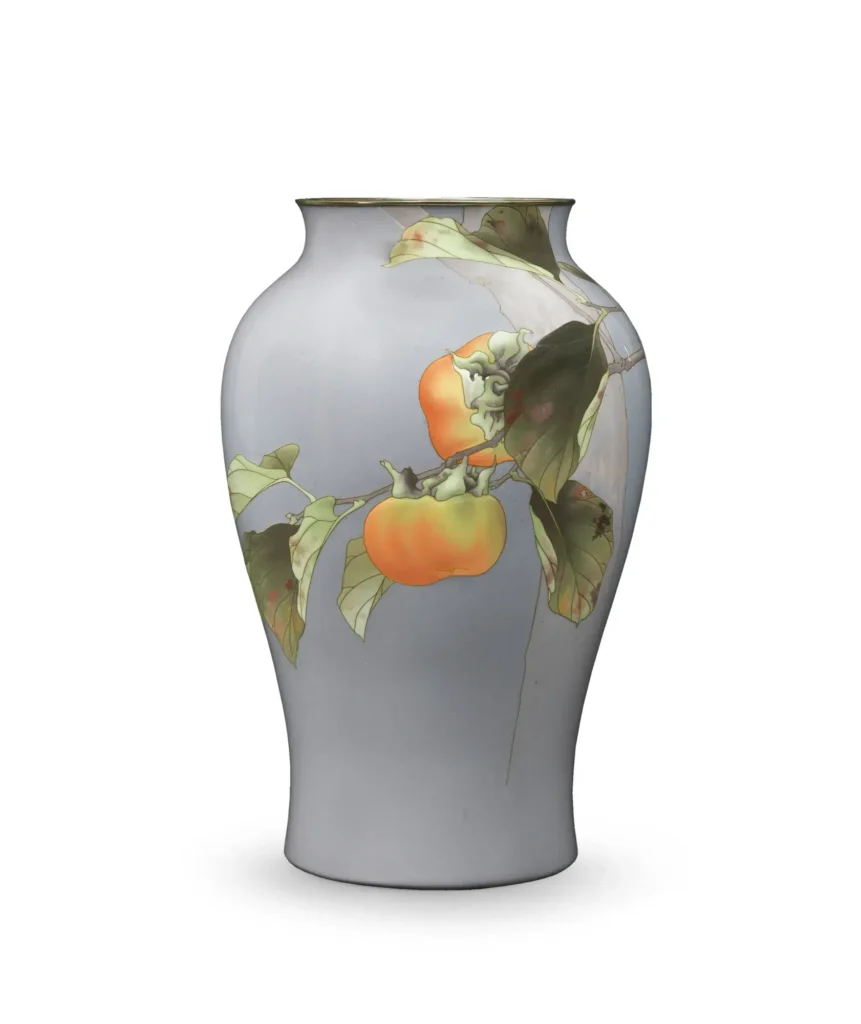
| moriage shippō | 盛上七宝 | Raised enamel. Enamel built up in layers to give relief. | Kawade Shibatarō ↗ |
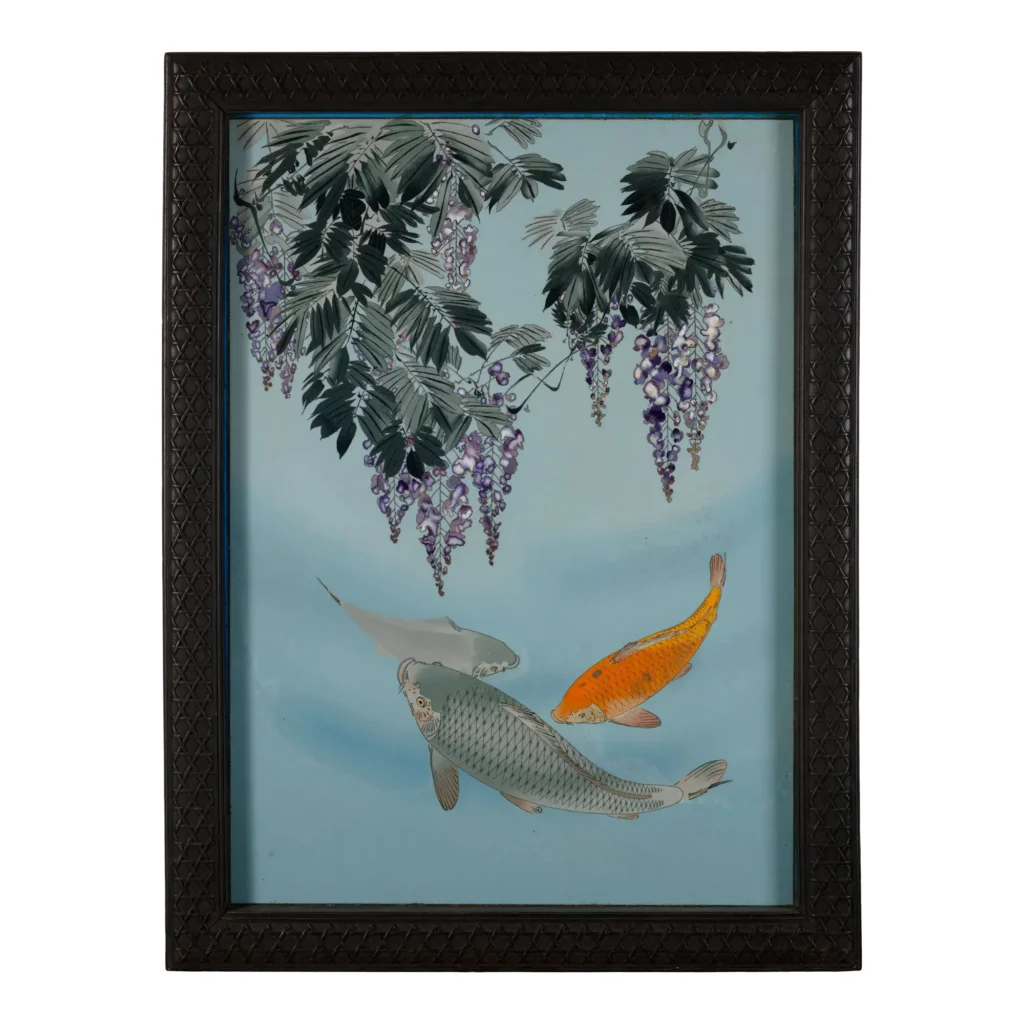
| musen shippō | 無線七宝 | Wireless cloisonné. Cloisonné with the wires removed before the final firing. | 濤川惣助 ↗ |
| Naikoku Kangyō Hakurankai | 内国勧業博覧会 | National Industrial Exhibition. Five government-led exhibitions held between 1877 and 1903 to promote industry and develop export goods. | 内国勧業博覧会 ↗ |
| nanako | 魚々子 | Also written 魚子, 斜子. Lit. fish-roe. 1 A pattern of small dots thought to resemble fish-roe, and usually used as a background pattern on metal fittings kanagu 金具. | JAANUS ↗ |
| nanga | 南画 | Lit. Southern painting. An abbreviation of nanshuuga 南宗画, which refers to painting of the Southern school in China. | JAANUS ↗ |
| natsume | 棗 | A tea caddy for storing weak green powdered tea. Also called usuchaki 薄茶器. | JAANUS ↗ |
| netsuke | 根付 | A miniature sculpture that is ties to a portable tiered container inroou 印籠 worn on the person for the purposes of carrying medicines in the form of pellets or powders. | JAANUS ↗ |
| nihonga | 日本画 | Lit. Japanese style painting. The term came into use during the Meiji period to distinguish indigenous painting from Western-style oil painting youga 洋画. | JAANUS ↗ |
| nishiki-e | 錦絵 | Lit. brocade pictures. A picture that resembles a colorful embroidered silk brocade, nishikinui 錦繍. | JAANUS ↗ |
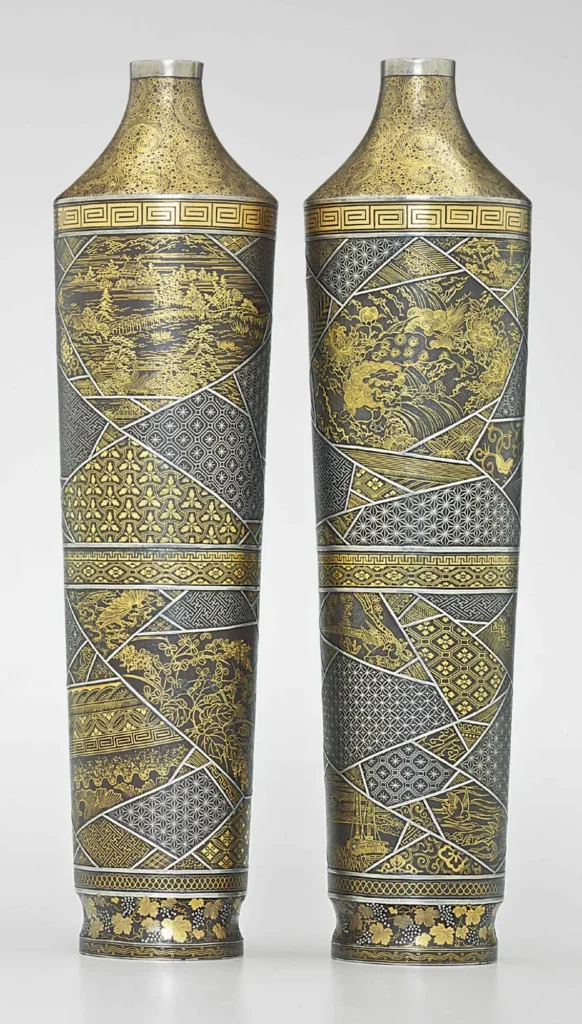
| nunome zōgan | 布目象嵌 | Textile inlay. Gold or silver hammered into a cross-hatched iron surface. | Damascene ↗ |
| okimono | 置物 | Ornament for display. A decorative object for display, such as in a tokonoma alcove; many were made for export in the Meiji period. | Okimono ↗ |
| oribeyaki | 織部焼 | Oribe 織部 ware. Produced mainly from 1600 to the 1630s, this high-fired pottery juxtaposing rich fluid glazes with abstract geometric designs resulted from technological innovations at the Mino 美濃 kilns. | JAANUS ↗ |
| raden | 螺鈿 | A shell, especially mother-of-pearl, inlay technique commonly used for lacquer ware makie 蒔絵. | JAANUS ↗ |
| rakkan | 落款 | An abbreviation of the term rakusei kanshiki 落成款識. Lit. inscription cast into ancient bronze vessels at completion. | JAANUS ↗ |
| rakuyaki | 楽焼 | Raku 楽 ware. A light weight ceramic ware developed in Kyoto in the Momoyama period and particularly prized in the tea ceremony chanoyu 茶湯, especially for teabowls chawan 茶碗. | JAANUS ↗ |
| Rinpa | 琳派 | A school of painters and decorative artists, which began in 17c Kyoto and then spread to Kanazawa and Edo. | JAANUS ↗ |
| rokushou | 緑青 | Also iwarokushou 岩緑青. A green pigment ganryou 顔料, made of powdered malachite, a form of basic copper carbonate. | JAANUS ↗ |
| rougata | 蝋型 | Also rougata chuuzou 蝋型鋳造, rougata imono 蝋型鋳物. A method of metal casting known as the lost-wax technique. | JAANUS ↗ |
| ryuu | 龍 | Also written 竜. Ch: long. A dragon. 1 Mythological animal and cosmological symbol of Chinese origin. | JAANUS ↗ |
| sabi | さび | ; architecture / general terms Also written 寂. 1 An idea of beauty particularly important in the tea ceremony and haiku 俳句 poetry. | JAANUS ↗ |
| sansuiga | 山水画 | Ch: shanshuihua. Lit. mountain and water painting. Far Eastern painting of an idealized nature. | JAANUS ↗ |
| satsumayaki | 薩摩焼 | Satsuma 薩摩 ware. A general name for pottery and porcelain made in Satsuma and Oosumi 大隅 in Shimazu 島津 fief (modern Kagoshima prefecture.). | JAANUS ↗ |
| seigaiha | 青海波 | Also pronounced seikaiha . A wave design made of the arches of concentric circles superimposed upon one another so that only the upper portion of each set of circles is visible. | JAANUS ↗ |
| setoyaki | 瀬戸焼 | Seto 瀬戸 ware. Pottery made in Seto city and nearby areas of modern Aichi prefecture. | JAANUS ↗ |
| shakudō | 赤銅 | Shakudō. A Japanese alloy of gold and copper patinated black or indigo. | Shakudō ↗ |
| shibuichi | 四分一 | Shibuichi. A copper-silver alloy patinated in greys and muted colours; the name means "one part in four". | Shibuichi ↗ |
| shigarakiyaki | 信楽焼 | Shigaraki 信楽 ware. Sueki 須恵器 ware was made in this clay-rich area from early times, but a distinctive ware fired in the Shigaraki Nagano 信楽長野 and Kouyama 神山 villages, in Kougagun 甲賀郡 of modern Shiga prefecture, probably originated at the end of the Heian period with the production of utilitarian… | JAANUS ↗ |
| shinoyaki | 志野焼 | Shino 志野 ware. One of the best known of Mino wares minoyaki 美濃焼 first produced in the Momoyama period. | JAANUS ↗ |
| shippou | 七宝 | Enamel, cloisonne or champleve. A decorative technique where areas of enamel are separated by metal dykes or wires. | JAANUS ↗ |
| shu | 朱 | Vermilion. An intense orange-red pigment ganryou 顔料, made of cinnabar shinsha 辰砂 (mercuric sulphide, HgS). | JAANUS ↗ |
| shōtai shippō | 省胎七宝 | Plique-à-jour. Enamel without a metal backing, so light passes through. | Kawade Shibatarō ↗ |
| sometsuke | 染付 | Blue-and-white ware. A white pottery with indigo patterns. On the surface of white pottery, mainly porcelain, designs are painted with cobalt oxide paint gosu 呉須, a coat of transparent glaze is applied and the vessel is fired at 1300-1350 c. Called qinghua (Jp: seika 青花), qinghua baici (Jp: seika… | JAANUS ↗ |
| sukashibori | 透彫 | Openwork. A method of decoration in which a design is cut out of a plain surface. | JAANUS ↗ |
| sumi | 墨 | Ink. Ink was made from lampblack, soot susu 煤 produced by the incomplete combustion of aged pine wood (the product is called shouenboku 松煙墨) or plant oil (the product is called yuenboku 油煙墨) mixed with glue nikawa 膠. | JAANUS ↗ |
| surimono | 摺物 | Lit. printed matter. High quality, privately sponsored woodblock prints mainly produced 1790's-1830's. | JAANUS ↗ |
| suzuribako | 硯箱 | A box designed to hold an inkstone suzuri 硯 and other writing tools, such as an ink stick sumi 墨 and ink-stick holder sumibasami 墨挾, water-dropper suiteki 水滴, brush fude 筆, small sword tousu 刀子, and awl kiri 錐. | JAANUS ↗ |
| takaukibori | 高浮彫 | High-relief decoration. Applied sculptural decoration on ceramics, associated with Makuzu Kōzan. | Makuzu Kōzan ↗ |
| tankin | 緞金 | Beating gold. Also called tanzou 緞造, uchimono 打物, tsuikin 鎚金 and kaji 鍛冶. | JAANUS ↗ |
| Teishitsu Gigei-in | 帝室技芸員 | Imperial Household Artist. An artist officially appointed by the Imperial Household to make works for the palaces; seventy-nine were appointed from 1890 to 1944. | Imperial Household Artist ↗ |
| tsuba | 鐔 | Also written 鍔. Sword guard. Tsuba protect the hand and balance the sword. | JAANUS ↗ |
| tōtai shippō | 陶胎七宝 | Cloisonné on a ceramic body. Cloisonné enamel applied to a pottery body, made by Kinkōzan among others. | 錦光山宗兵衛 ↗ |
| ukibori | 浮彫 | Formerly known as hanshutsuzou 半出像. A relief, or a method used to carve a relief on a flat surface. | JAANUS ↗ |
| ukiyo-e | 浮世絵 | Lit. pictures of the floating world. Paintings and woodblock prints of genre themes developed from the mid-Edo to early Meiji periods, supported by the people in the middle class of society ( shomin 庶民, or common people) mainly in the city of Edo. | JAANUS ↗ |
| urushi | 漆 | Lacquer. A non-resinous sap taken from Rhus verniciflua, a tree which grows East Asian countries. | JAANUS ↗ |
| wabi | わび | ; art history / general terms Also written 侘 or 佗. An aesthetic ideal that finds surpassing beauty and deep significance in what is humble or commonplace and appears natural or artless. | JAANUS ↗ |
| washi | 和紙 | Handmade Japanese paper made from long natural fibers. Most commonly used fibers include mulberry kouzo 楮 (see choshi 楮紙), hemp asa 麻 (see mashi 麻紙), diplomorpha sikokiana ganpi 雁皮 (see ganpishi 雁皮紙), and edgeworthia papyrifera mitsumata 三椏 (see mitsumatagami 三椏紙). | JAANUS ↗ |
| yamato-e | やまと絵 | Also written 大和絵 and 倭絵. A widely used description term which has carried various nuances in different periods, but generally applied to paintings whose subject matter, format and/or style are considered "Japanese," as opposed to something "foreign," or "Chinese." The… | JAANUS ↗ |
| yuugen | 幽玄 | Lit. profound mystery. A multivalent and influential medieval aesthetic ideal expressing darkness, depth, mystery, transience, ambiguity, calm, sadness, and elegance. | JAANUS ↗ |
| yūsen shippō | 有線七宝 | Wired cloisonné. Cloisonné with wire outlines retained; the representative technique of Owari cloisonné. | 尾張七宝 ↗ |
| zougan | 象嵌 | Inlay. It is also written 象眼 (elephant eye). A decoration technique in which the surface of such materials as metal, pottery and wood is carved and filled with metal, stone, shell, ivory or horn. | JAANUS ↗ |
Descriptions record our research and opinion as of 20 October 2026. Works are offered as described. Please see our Terms of Sale.
Terms in practice