Knowledge · Reading Meiji 明治
Telling Meiji work from later work
What the documented record shows about dating and attribution, and how we weigh it. This is a guide to evidence, not a means of judging any single object at a distance.
The Meiji era ran from 23 October 1868 to 30 July 1912. A work "of the Meiji period" was therefore made within those dates, and many makers worked on into the Taishō era (1912–26). [Meiji era]
The market these works were made for changed quickly. English Wikipedia notes that the term Satsuma ware spread from fine painted wares to include low-quality pieces mass-produced for export. After the Meiji era foreign demand fell: Namikawa Yasuyuki's workshop closed in 1923 and Yabu Meizan's in 1926. [Yabu Meizan] [Namikawa Yasuyuki]
Names continued after their founders. Yabu Meizan's adopted son Yabu Tsuneo used the Meizan signature on his own work, and another workshop used Meizan's name and imitated his style. The Metropolitan Museum notes that Hayashi Kodenji I and II worked together for decades and that the hand behind a given piece often cannot be established. [Yabu Meizan] [Pair of Vases with Kingfishers]
Imitation of age is recorded in the period itself: our source on Makuzu Kōzan reports Frank Brinkley's allegation, partly accepted by Pollard, that new Satsuma was distressed for sale as antique in the 1870s. [Makuzu Kōzan]
Techniques have documented beginnings. Musen cloisonné is dated to 1879; Namikawa Yasuyuki had learned to hide background wires by 1893; moriage was developed by Kawade and Hattori; and Japanese plique-à-jour followed Ando's purchase of a French example in 1900. A piece in a given technique cannot be earlier than the technique. [濤川惣助] [Namikawa Yasuyuki] [Kawade Shibatarō]
Imperial presentation wares often bear the sixteen-petalled chrysanthemum crest, and Imperial Household Artists made many of them. [Imperial Household Artist]
Interpretation
A crest, a signature or a "Dai Nihon" mark records how a piece was marked; on its own it is not enough. Marks were copied, workshop names outlived their founders, and some trading companies sold under their own names. We read a mark together with the technique, the form, the quality of the work and any documented history.
Interpretation
The most useful comparisons are with documented works: pieces in public collections with a recorded exhibition history, such as the Chicago 1893 gifts in the Tokyo National Museum or the V&A's 1883 purchases, and the illustrated exhibition catalogues of 1904 and 1910, which are public domain on the Internet Archive.
Interpretation
Collectors' rules of thumb can help, but they are not laws. One example is the satsuma-database view that an impressed Taizan mark points to a date before about 1894. We cite such rules where we use them and treat them as working hypotheses. [Taizan Yohei]
Interpretation
In a record we set out what each line of evidence shows and what it does not. Condition is examined under UV light and magnification, and anything uncertain is labelled as such. This is our research opinion as of the date written, and every record says so.
If you would like us to look at a work, please write to us. We give our research view; we do not issue certificates or valuations.
Descriptions record our research and opinion as of 20 October 2026. Works are offered as described. Please see our Terms of Sale.
One maker, two decades
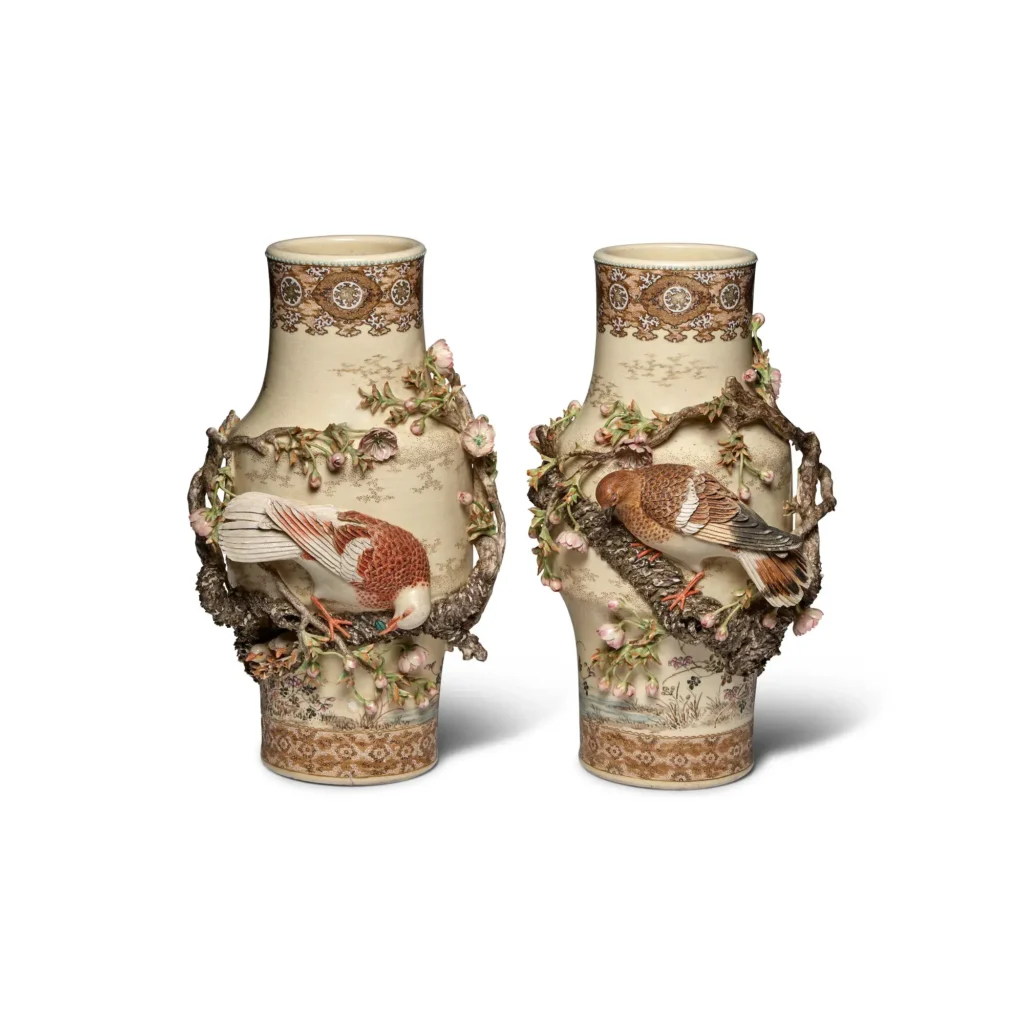
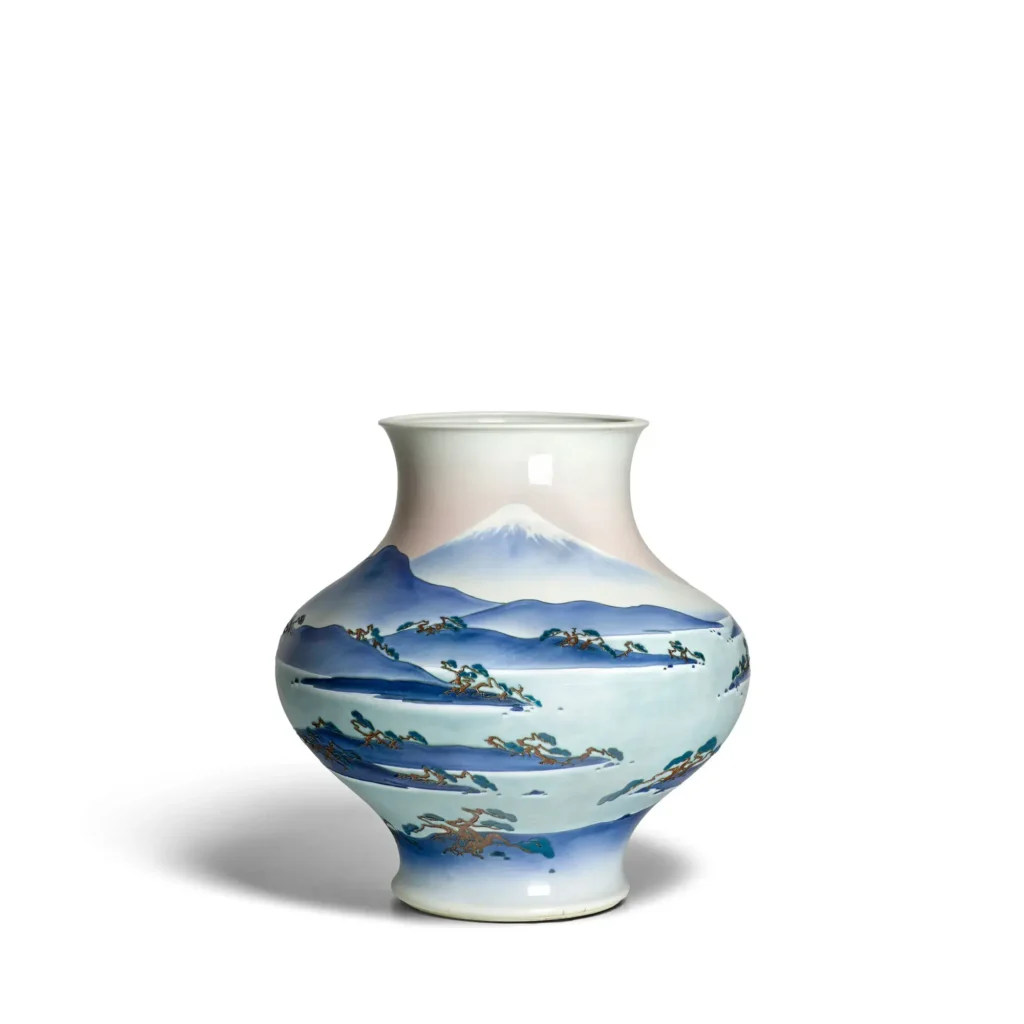
Bonhams contrasts Kōzan’s high-relief stoneware of the 1870s with “his later emulations of Chinese imperial porcelain”. The two lots below, both catalogued by the house, show the difference. Style alone does not date an object; the catalogues also rely on marks and comparisons.