Lot description
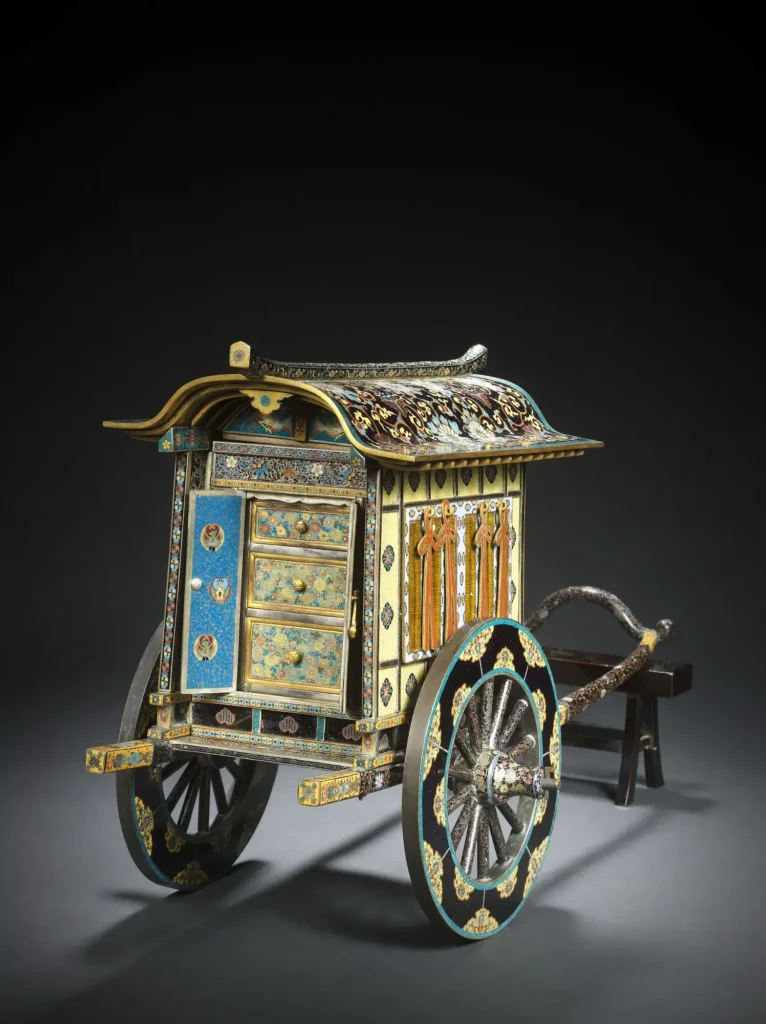
A rare, unusual and elaborately decorated cloisonné enamel goshoguruma (ox-drawn carriage)
Attributed to Kawaguchi Bunzaemon of Nagoya, Meiji Period
Conceived in several detachable sections, intricately worked in silver and gilt wire with stylised designs of colourful birds and flowers, foliate motifs and confronting phoenixes, the front and sides of the cart inset with plaques in the form of sudare, rendered in transluscent yellow, from which are suspended detachable metal ribbons; the front with various floral mon scattered on a plain yellow ground; the reverse with a hinged double-door opening to reveal three drawers within; the detachable roof with kiri-mon and kiku-mon interwoven among karakusa on a black ground, the axles and two-spoked wheels decorated with foliate motifs and flowerheads on a black ground between bands of geometric patterns on a turquoise ground, the pair of long parallel shafts and yoke embellished with matching patterns consisting of stylised kiku-heads amidst tightly-scrolled karakusa on a yellow and black ground; unsigned, with two lacquered wood stands. 28.2cm x 36cm x 14cm (11 1/16in x 14 1/16in x 5½in). (15).Footnotes
七宝置物 御所車 伝川口文左衛門 明治時代
Another similar goshoguruma is published and illustrated: Bessatsu Taiyo: Meiji no Soshoku Kogei, p.92, ed., Kaneko Kenji, Heibonsha, Tokyo, 1990.
In modern times the miniature goshoguruma is a composite feature of the Hinamatsuri (Doll’s Festival of Girl’s Day) repertoire and is displayed on the sixth or seventh tier of the Hina doll platform.
Quoted from the lot page, © Bonhams. Bonhams, Fine Japanese Art, 2009-11-05, lot 240 ↗
Public historical auction result, cited to the auction house’s own lot page. It records what one object made on one day. It is not a valuation of any work, and nothing here is offered for sale.