Lot description
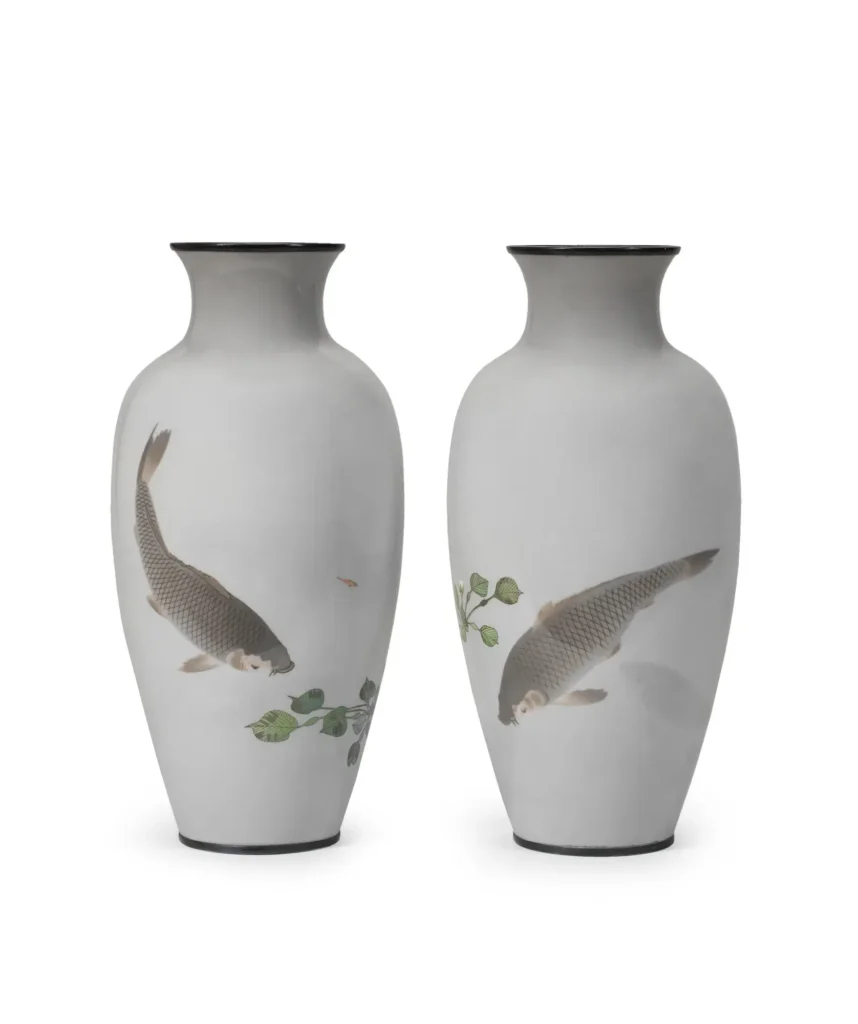
A fine pair of slender cloisonné-enamel baluster vases
By Namikawa Sosuke (1847-1910), Meiji era (1868-1912), late 19th century
Each delicately worked in musen (wireless) and shosen (partially wireless) technique and forming a complementary design, one large koi (carp) on one vase and two on the other, one partially obscured by the cloudy water and a shoal of medaka (rice fish) swimming amidst flowering white hishi (Japanese water caltrop) on a pale white-grey ground, graduating to white-green towards the bottom, the scales of two carp and the veins of the green leaves outlined in silver wire, the fins of the rice fish subtly highlighted in gold wire, each vase applied with a shakudo rim and foot, each signed on the base in thick silver wire with a single character Sakigake (the seal of Namikawa Sosuke). Each vase 36cm (14 1/8in) high. (2).Footnotes
Provenance
A French private collection.
One of the greatest craft entrepreneurs of the later Meiji era, Namikawa Sosuke was until recently best known in Japan for a set of 32 decorative panels commissioned for Tokyo’s Akasaka Rikyu Palace, completed in 1909. These date from the last years of his very productive life, nearly three decades after he began to experiment with the technique known as musen shippo (wireless enameling), his most enduring contribution to an art form that developed at extraordinary speed in Japan between the mid-nineteenth century and the early years of the twentieth century. In Chinese cloisonné enameling, the wires separating the different areas of fused and polished enamels that made up a design also served to hold the enamels in place during the firing process, and the individual areas of color were relatively small. Sosuke, followed shortly after by his rivals, managed to improve the chemistry of the enamels so that they adhered more securely to the metal bases of his wares, allowing him to introduce large areas of color into his designs, although it is thought that wires between different colors still had to be painstakingly applied and removed at each stage of manufacture. Thanks to these and other technical breakthroughs, later Meiji-era enamelers were often able to emulate the effects of brush painting on paper or silk. In recognition of his achievements, in 1896 Sosuke was appointed to the order of Teishitsu Gigeiin (Artist-Craftsman to the Imperial Household).
Quoted from the lot page, © Bonhams. Bonhams, Fine Japanese Art, 2017-11-09, lot 209 ↗
Public historical auction result, cited to the auction house’s own lot page. It records what one object made on one day. It is not a valuation of any work, and nothing here is offered for sale.