Lot description
Property of Various Owners
MAKUZU (MIYAGAWA) KŌZAN (1842-1916)
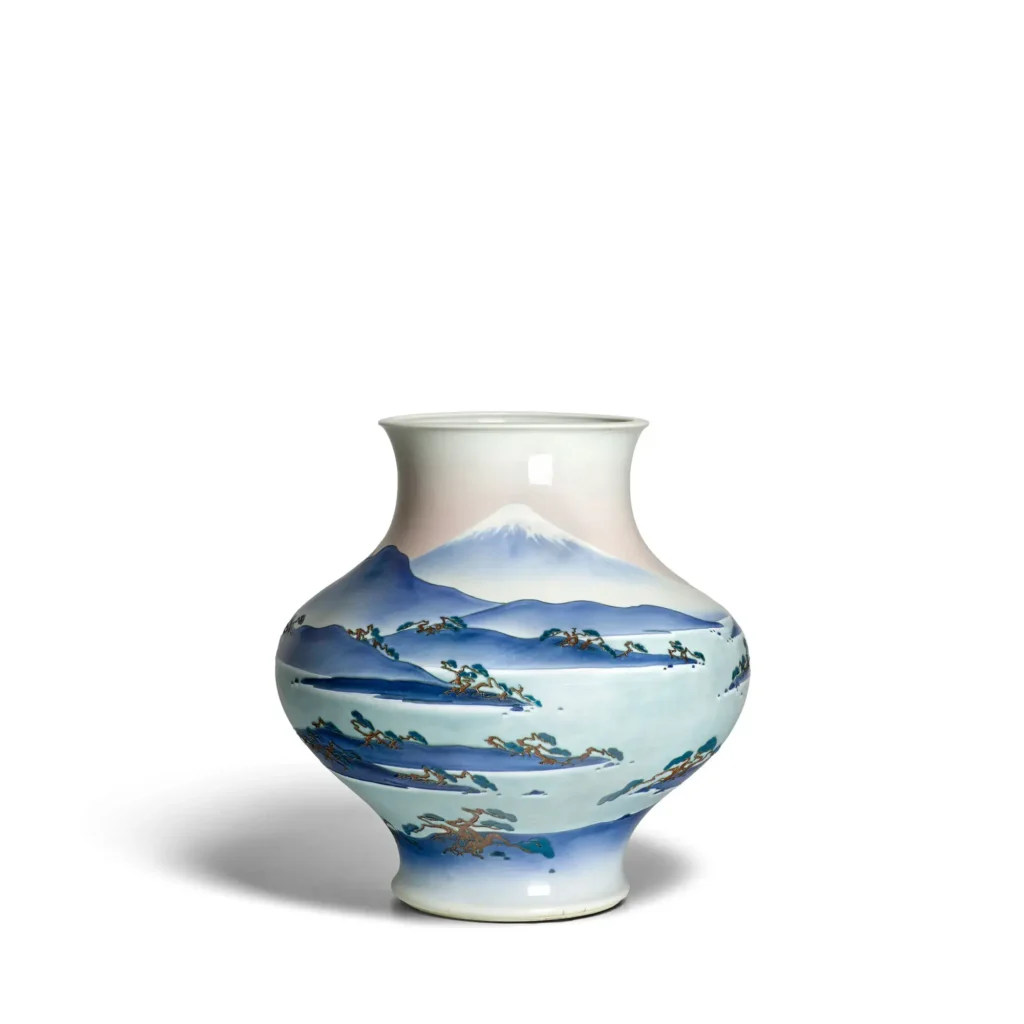
A Large and Impressive Porcelain Vase with Mount Fuji
Meiji era (1868-1912), circa 1910
The compressed ovoid vase with a short flaring neck and everted rim painted in underglaze blue with green and brown enamels on a light green and graduated blue and pink ground with a view of Mount Fuji from the surrounding lakes, the islands with a raised border and the pine trees carved in sunken relief and painted in dark enamels, the graduated pink ground suggestive of an evening sky, signed in underglaze blue in a rectangular reserve Makuzu gama Kōzan sei
20 1/2in (52cm) high; 20in (50.8cm) diameterFootnotes
Miyagawa Kōzan was one of the most innovative ceramic artists and entrepreneurs of Meiji-era Japan. After establishing his Makuzu factory in the international port city of Yokohama, he developed a body of work that balanced technical virtuosity with a sophisticated awareness of global taste, helping to define Japanese ceramic art for the world stage. He exhibited widely at international expositions and earned numerous awards, contributing significantly to Japan’s cultural diplomacy. His larger porcelain vessels, in particular, are remarkable for their ambition and sculptural presence: Monumental vase forms transformed into sites for experimentation with high-relief decoration, underglaze painting, newly developed glaze effects, and variations on imperial Chinese porcelain designs. Whether adorned with intricate relief work or luminous cobalt-blue landscapes, these commanding porcelains embody the technical innovation, artistic confidence, and international outlook that made Kōzan one of Japan’s greatest ceramic masters.
Quoted from the lot page, © Bonhams. Bonhams, Fine Japanese & Korean Art, 2026-09-16, lot 1077 ↗
Public historical auction result, cited to the auction house’s own lot page. It records what one object made on one day. It is not a valuation of any work, and nothing here is offered for sale.