Lot description
PROPERTY OF VARIOUS OWNERS
MAKUZU (MIYAGAWA) KŌZAN (1842-1916)
A Magnificent Pair of Stoneware Vases
Meiji era (1868-1912), mid/late 1870s
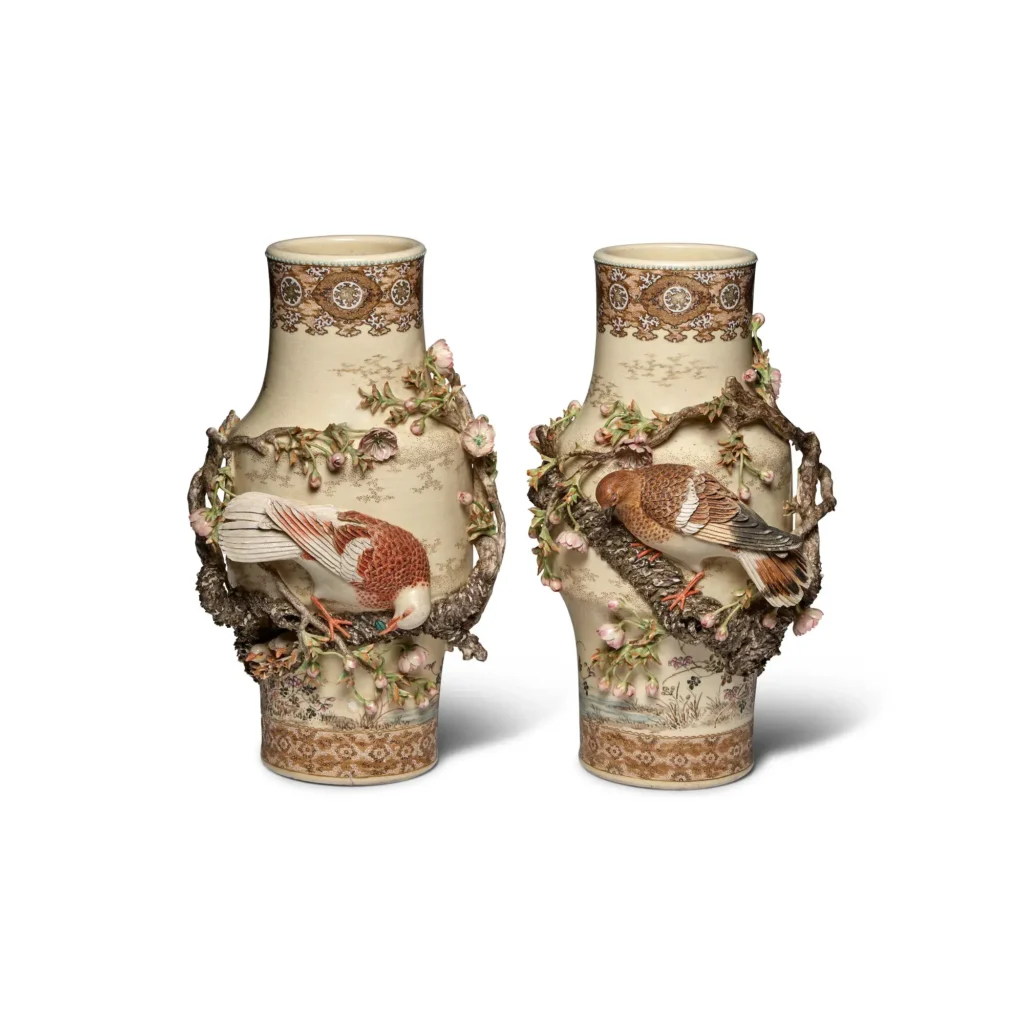
A pair of stoneware vases of broadly cylindrical form with wider central sections and slightly flared mouths, each covered in a crackled-cream Satsuma-style glaze and modeled in very high undercut polychrome relief respectively with a male and a female bird on a flowering tree branch, the reverse of the vase with the female bird also with two nestlings in the hollow of a tree trunk, the grounds further decorated in gold and colors with flowering plants, the necks and feet with bands of floral ornament, each with a numbered handwritten label in Japanese on the base
17in (43.2cm) high (2).Footnotes
In the summer of 1871 Makuzu Kōzan left the family workshop in his native Kyoto (Japan’s former capital) and moved 300 miles east to the newly opened international port of Yokohama near Tokyo in search of business opportunities. He quickly set up a kiln and started to manufacture ceramics for the export market, copying elements of the “Satsuma” style that was so popular in the treaty ports during the early Meiji era, but working at much larger scale and with a hitherto unseen degree of elaborate high relief. Kōzan was soon winning prizes at international expositions in Vienna (1873) and Philadelphia (1876) as well as at the first Naikoku Kangyō Hakurankai (National Industrial Exposition), held in 1877 in preparation for the Exposition Universelle held in Paris the following year: a piece of this type was actually touched by the Meiji Emperor at the 1877 show and later purchased for the Imperial collection, cementing Kōzan’s reputation. Despite domestic criticism of his pursuit of intricacy for its own sake, Kōzan worked in this style for several years, confident that European buyers steeped in high Victorian taste would continue to expect Oriental wares to be fantastic, even grotesque.
These two striking vases are similar to one acquired by the Victoria and Albert Museum (then the South Kensington Museum) in 1879 (inv. no.308-1879) and at first mistakenly thought to date from the eighteenth century! After decades languishing in storage, the V&A vase caused a stir when it was unearthed and included in the museum’s Toshiba Gallery of Japanese Art, opened in 1986. Makuzu Kōzan’s early production, so different from his later emulations of Chinese imperial porcelain, bears eloquent testimony to the technical ingenuity and commercial acuity of the great Meiji-era craft entrepreneurs.
Quoted from the lot page, © Bonhams. Bonhams, Fine Japanese and Korean Art, including the Alan and Simone Hartman Collection of Japanese Art, 2024-09-18, lot 802 ↗
Public historical auction result, cited to the auction house’s own lot page. It records what one object made on one day. It is not a valuation of any work, and nothing here is offered for sale.