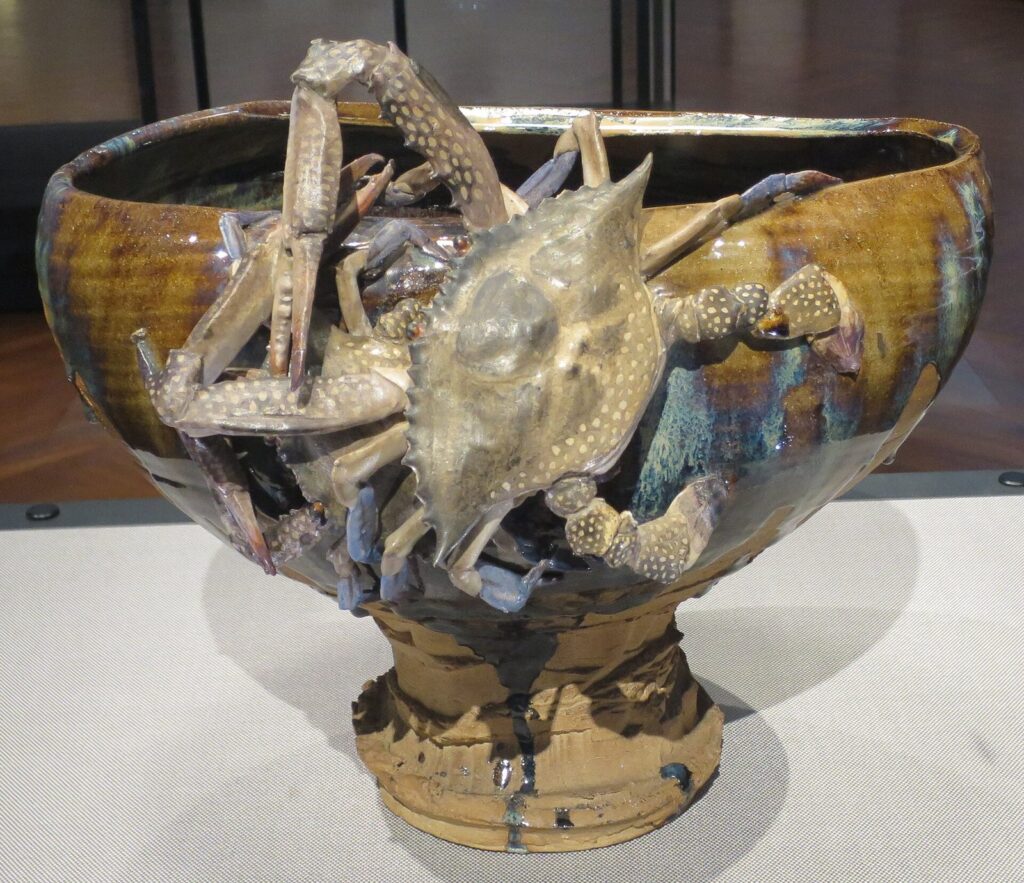
Reference · Tokyo National Museum Footed bowl with crab and brown glaze by Miyagawa Kozan I, 1881. CC0 (by Hiart). Source ↗
I · Identification & Maker
Maker: Miyagawa (Makuzu) Kozan I (1842–1916) · 初代宮川香山
Date / period: 1881
Collection / last record: Tokyo National Museum G-105; Important Cultural Property 2002 no. 02607
II · Technical Masterwork Criteria
Stoneware (陶製, not porcelain); brown glaze with flowing straw-ash glaze; two near life-size applied crabs painted in overglaze
Teishitsu Gigeiin: Teishitsu Gigeiin 30 Jun 1896 (Miyagawa Kozan; en.wikipedia.org · Imperial Household Artist ↗)
Exposition / provenance: Shown at the 2nd National Industrial Exhibition 1881; the only early Kozan work with firmly documented date and exhibition (bunka.go.jp)
III · Iconography & Cultural Meaning (interpretive)
crab: kani, realism tour de force; armour-like shell
Philosophical context (INTERPRETIVE, except the sourced Haitorei fact). The 1876 Haitorei decree banned samurai from wearing swords in public, depriving sword-fitting artisans of their market, so many turned to export art (sourced: antiquesandthearts.com · samurai to the imperial court japanese metalwork ↗). Meiji export pieces often favour dense, virtuosic surface (horror vacui for Western taste), in tension with native ideals of yugen (subtle depth), wabi-sabi (imperfect, transient beauty) and shibui (restrained elegance). The finest makers (Meizan's negative space, Yasuyuki's monochrome grounds, Seifu's celadons) reconcile the two.
IV · Marks 落款 & box
Mark / seal as published: Not captured
Tomobako: n/a
Sources: artplatform.go.jp · W137750 ↗ · online.bunka.go.jp · 198986 ↗
Assessment
See how we score
| Maker stature | 2.5 / 2.5 |
| Recognition (museum / designation / price) | 3 / 3 |
| Exhibition | 1 / 1 |
| Technique (cited) | 1.5 / 1.5 |
| Provenance | 1 / 1 |
| Condition, scale & documentation | 1 / 1 |
| Total | 10 / 10 |
Reasoning: Gigeiin; ICP 2002; 2nd National Industrial Exhibition 1881; the only early Kozan with firmly documented date and exhibition. How we score.
Maker context
Miyagawa Kōzan I was born Miyagawa Toranosuke in 1842 into a Kyoto potting family. His father, Makuzu Chōzō, had studied with Aoki Mokubei. He took over the family business in 1860, at the age of eighteen, and at first made tea utensils. In 1867 he accepted an invitation from Igi Tadazumi to work at the Igi family kiln at Mushiage, near Bizen, where he made blue-and-white wares for two years.
In 1870 he set up a workshop in Yokohama, which had recently opened as a treaty port, at the invitation of a Tokyo merchant interested in exporting Satsuma ware. The kiln was called Ōta. After a serious fire in 1876 he rebuilt it at his own expense and went on to sell his work on his own account.1
Summarised from our maker page, where every fact is footnoted: Makuzu (Miyagawa) Kōzan I 宮川香山.
Notes to “Maker context”
- Makuzu Kōzan, English Wikipedia ↗
Related records

Descriptions record our research and opinion as of 20 October 2026. Works are offered as described. Please see our Terms of Sale.