Lot description
Sozan for the Kinkozan workshop (circa 1900)
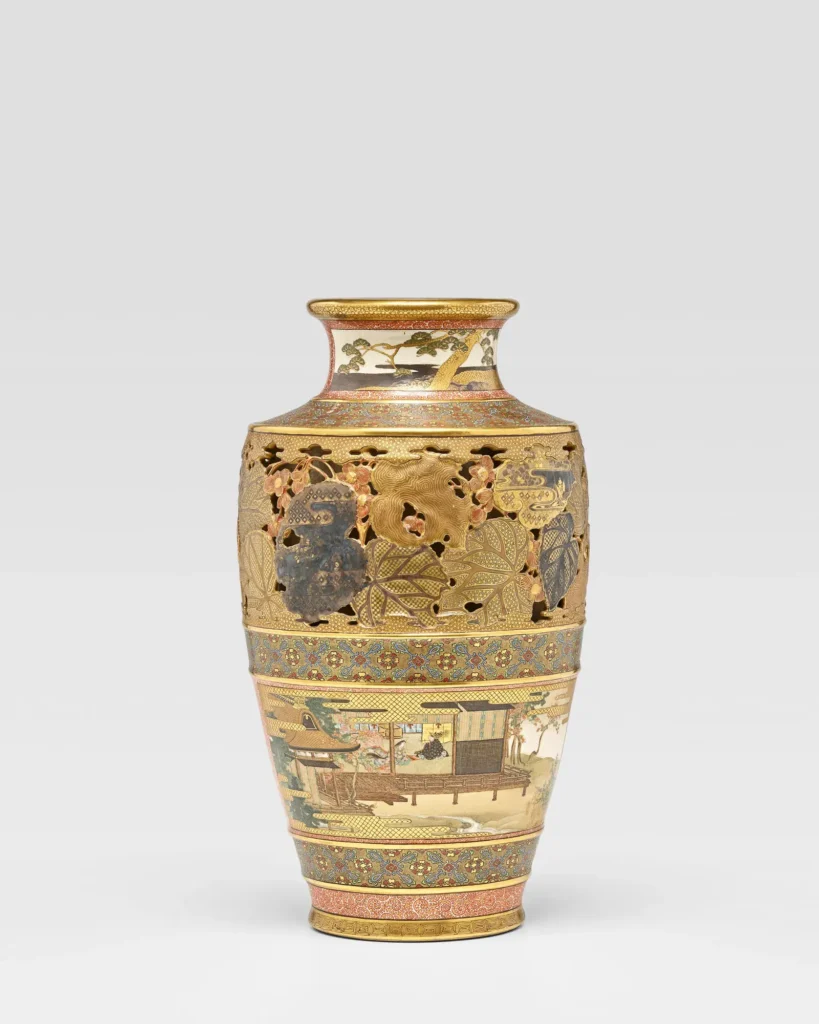
A fine and rare reticulated Satsuma vase
Meiji era (1868-1912), early 20th century
Decorated in polychrome enamels, silver and gilt, the vase divided into two registers, the lower painted with a Muromachi-style simulated ink landscape, and a scene of courtiers within a well-appointed villa, each scene separated by scrolling vines, the upper register with a continuous reticulated design of insect-eaten leaves and flowers painted with geometric designs, and scenes of blossoming flowers, all banded by clouds painted in stipled gilt, each register divided by bands of stylized blossoms with raised borders, the decoration continued on the shoulder, the neck decorated with pine trees, the rim and foot with floral keyfret designs, signed on the underside Sozan in red enamel, and Kinkozan tsukuru in gilt and an illegible impressed seal
11 1/4in (28.6cm) highFootnotes
This and the following lot are examples of the very highest standard of design and workmanship achieved by the leading Kyoto ceramic factories at the apogee of the so-called “Satsuma” style. Kinkozan Sobei VII (1868-1928), son of Sobei VI (d.1884) and the owner of the Kinkozan factory during that glorious period, is thought to have exhibited first at the 1888 Barcelona International Exhibition, and subsequently at the Paris (1889), Chicago (1893), Paris (1900), and St. Louis (1904) Expositions and the Japan-British Exhibition held in London in 1910, as well as at several Naikoku Kangyo Hakurankai (Domestic Industrial Exhibitions) in Japan. Although the factory’s most elaborate and intricate wares fell out of favor with exhibition jurors from around 1900, they continued to appeal powerfully to the prevailing European and American taste for the exotic and fantastic. This was a time when discerning collectors of Japanese arts and crafts were growing increasingly aware of earlier Japanese, art, lore, and legend. In response, Kinkozan’s complex figural designs often captivatingly evoked Japan’s glorious past through depictions of the world of Prince Genji, the eleventh-century romantic hero (lot 2208), or convincing evocations of medieval ink painting (lot 2207). For an example of a Kinkozan vase combining openwork with figural scenes in the Khalili Collection, see Oliver Impey et al., The Nasser D. Khalili Collection, vol.5, Ceramics, part II: Earthenware, London, Kibo Foundation, 1995, no.167.
Quoted from the lot page, © Bonhams. Bonhams, Fine Japanese and Korean Art, 2018-03-21, lot 2207 ↗
Public historical auction result, cited to the auction house’s own lot page. It records what one object made on one day. It is not a valuation of any work, and nothing here is offered for sale.