Lot description
MYOCHIN SCHOOL
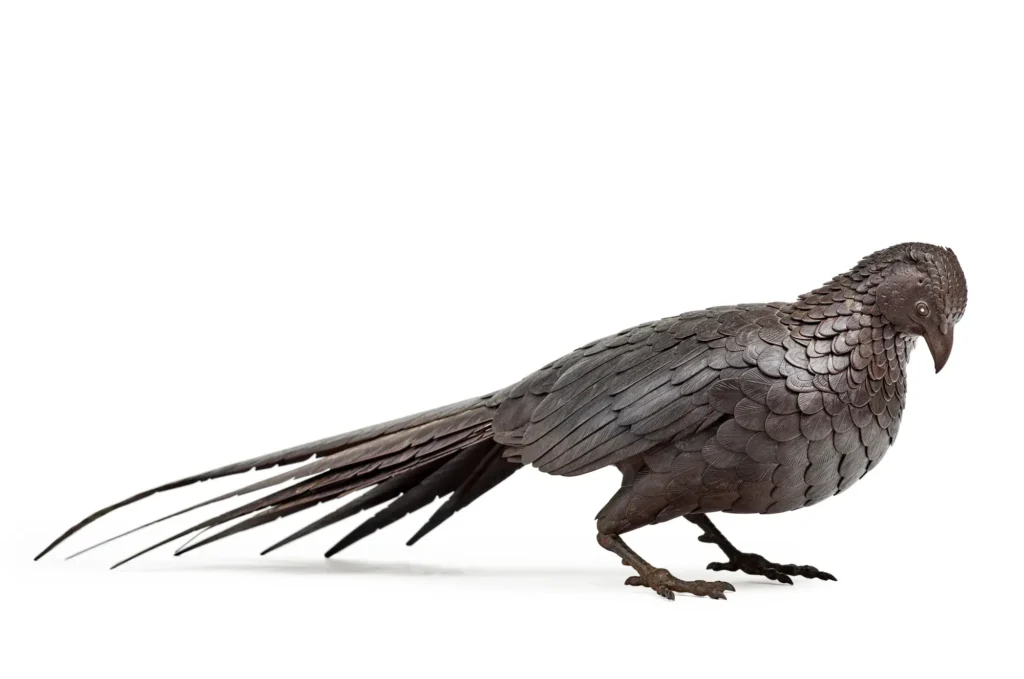
An Iron Kusshin Jizai (Fully Articulated) Okimono (Table Ornament) Model of a Pheasant
Meiji era (1868-1912), late 19th/early 20th century
Realistically rendered, life-size, constructed of extremely smoothly moving parts, the head can be turned 180 degrees, while the neck, tail and wings can be shortened or stretched out at will as implied by the term kusshin (‘bending and stretching’), the eyes inlaid in gilt, signed beneath the tail Kozan with a kao on an added signature plaque. 20cm x 75cm (7 7/8in x 29½in).Footnotes
Provenance:
A European private collection.
Of all the categories of Edo-period artefacts eagerly collected outside Japan for the last century and a half, articulated animals and birds have left the least trace of documentary evidence concerning their origin and development. Even the Japanese word for them, jizai or jizai okimono, appears to be a post-Edo term. However despite the obscurity of their origins, these displays of Oriental dexterity perfectly matched a trend in Western taste in the last quarter of the nineteeth century. They were first highlighted in Le Japon Artistique of 1881 which reproduces in three different positions, and describes in detail, an articulated frog. Surprisingly, it seems that jizai okimono were not brought fully to the attention of Japanese audiences until October 1983, when several examples were displayed in the special exhibition Japanese Metalwork held at Tokyo National Museum.
Quoted from the lot page, © Bonhams. Bonhams, Samurai, Beauties, and Townsmen: Japanese Art in Peace and War, 2023-05-18, lot 139 ↗
Public historical auction result, cited to the auction house’s own lot page. It records what one object made on one day. It is not a valuation of any work, and nothing here is offered for sale.