Journal · Essay
Namikawa and Namikawa: two roads to cloisonné
Two men named Namikawa, unrelated, working in Kyoto and Tokyo, were appointed Imperial Household Artists on the same day in 1896. They are still the only cloisonné artists ever to hold the title. This essay sets out what the sources record about how each came to the craft, how their techniques differed, and what the evidence does and does not support about the familiar contrast between them.
Two beginnings
Namikawa Yasuyuki was born in 1845 into a family whose original name was Takaoka and served as a samurai before taking up cloisonné around 1868.1 Between 1871 and 1874 he worked for the Kyoto Cloisonné Company, and he then set up his own workshop in Kyoto, where he sometimes signed his work Kyoto Namikawa.1 His route into the craft was that of a man of the old warrior class looking for a new livelihood in the first years of Meiji.
Namikawa Sōsuke’s route was commercial. Born in 1847 in Shimōsa Province, the second son of a farming family, he became a merchant dealing in ceramics. Japanese Wikipedia records that in 1877 he visited the first National Industrial Exhibition in Ueno and turned to cloisonné, and that in the same year he bought the Ahrens & Co. cloisonné works at Kameido in Tokyo, which employed craftsmen from Owari. In 1887 he also bought the Tokyo branch of the Nagoya cloisonné company.2 A Bonhams essay adds that the Shippō Gaisha (Enamel Company) was taken over by Namikawa during the 1880s and moved from Nagoya to his Tokyo headquarters.3
The two biographies thus begin differently: one with a craftsman who learned in a company and then worked under his own name, the other with an entrepreneur who acquired workshops and their skilled workers. Both pictures come from secondary sources, and we report them as such.
Black ground and wireless enamel
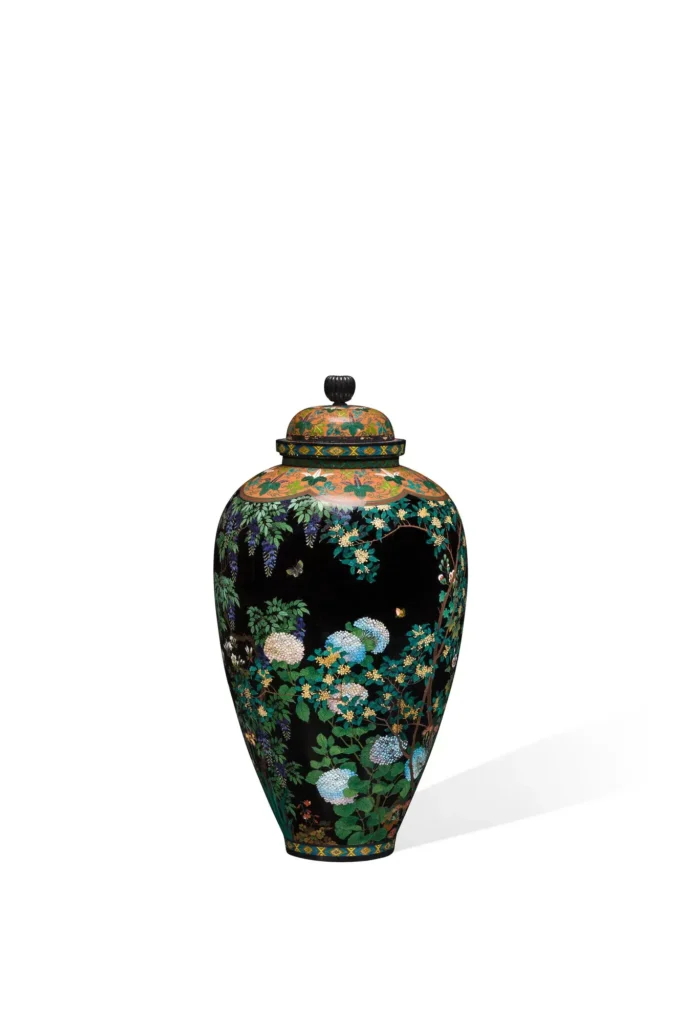
Yasuyuki’s reputation rests on wired cloisonné of great precision. English Wikipedia records that, with the German scientist Gottfried Wagener, engaged by the Meiji government, he developed a semi-transparent mirror-black enamel that became a hallmark of the workshop, and that by 1893 he had learned to hide the background wires and so create unbroken fields of enamel.1 The Tokyo National Museum, describing a pair of vases of 1892 in its collection (G-605), calls his black glazes celebrated.4 Auction catalogues describe the same combination in their own words: a vase sold by Bonhams in 2019 is “worked in polychrome enamels and silver wire with birds and butterflies in a variety of blossoming flowers, all against a black ground”.5
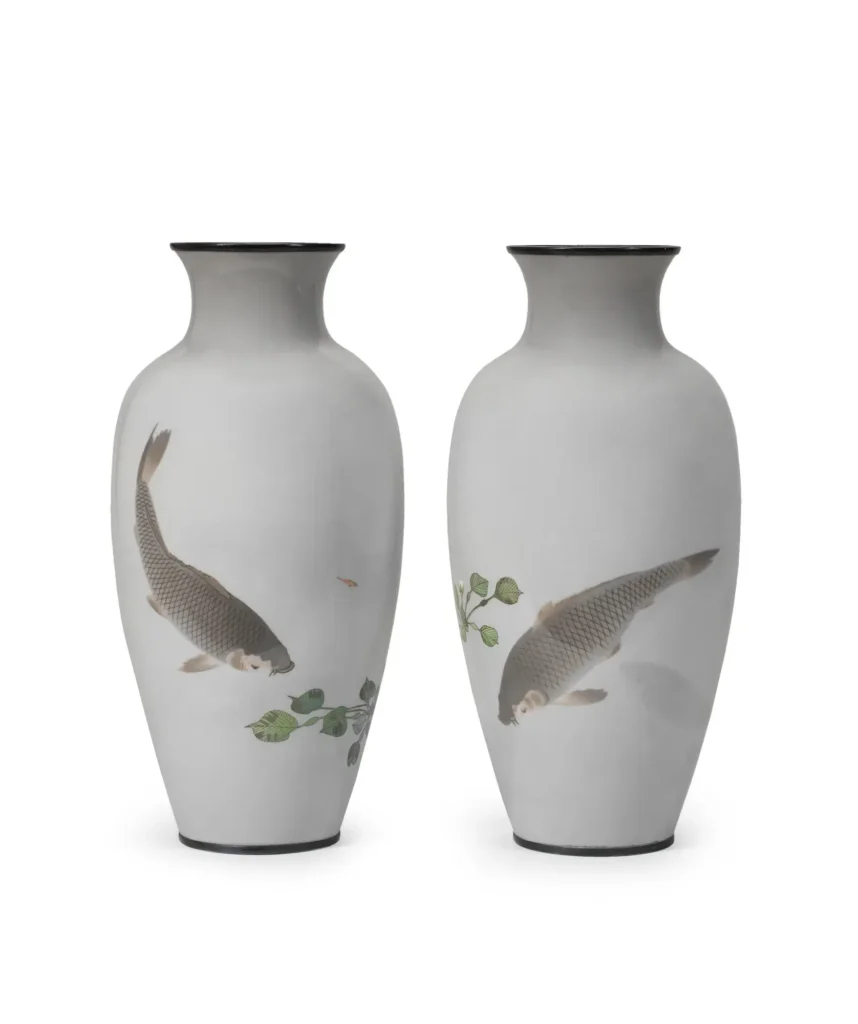
Sōsuke’s name is linked above all with musen, wireless cloisonné. In this technique the wires that divide the colours are removed before the final firing, so that colours can meet in soft gradations. Japanese Wikipedia dates his invention of the method to 1879; English Wikipedia adds that Wagener helped develop it, but that Namikawa later took credit for it.26 He also used shōsen, in which most of the wire is removed and only fine detail remains, and he often reproduced designs by the nihonga painter Watanabe Seitei.6
A Bonhams essay of 2017 explains the technical point more fully. In Chinese cloisonné, it says, the wires that separated the colours also held the enamels in place during firing, so the individual areas of colour were relatively small. Sōsuke “managed to improve the chemistry of the enamels so that they adhered more securely to the metal bases of his wares, allowing him to introduce large areas of color into his designs”, although wires between different colours probably still had to be applied and removed at each stage.7 The pair of vases that essay accompanies is catalogued as “worked in musen (wireless) and shosen (partially wireless) technique”.7
Exhibitions and the imperial title
Both men built their reputations at exhibitions. English Wikipedia records that Yasuyuki won prizes at 51 exhibitions between 1875 and 1915; that a copper vase took a second prize at the 1881 National Industrial Exhibition; that at the fourth exhibition, in 1895, he won first prize, the judges praising his fine wirework and a surface free of pitting or bubbles; and that he won a gold prize at St Louis in 1904. His Vase with Birds and Flowers of the Four Seasons, made in 1899, won a gold prize at the Paris Exposition Universelle of 1900 and is now in the Museum of the Imperial Collections.1
Sōsuke won an honorary gold medal at the 1881 National Industrial Exhibition, awards at Amsterdam and Nuremberg in 1885 and at Paris in 1889, and a Grand Prize at St Louis in 1904. His Mount Fuji plaque, shown at Chicago in 1893, is in the Tokyo National Museum and was designated an Important Cultural Property in 2011.62
Both were appointed Imperial Household Artists (Teishitsu Gigeiin) on 30 June 1896, in a group that also included Miyagawa Kōzan, Unno Shōmin and Suzuki Chōkichi.8 Bonhams states that Sōsuke’s appointment was “in recognition of his achievements”.7 The title brought commissions. Sōsuke’s best-known is the set of enamel panels of flowers and birds after Watanabe Seitei for the Akasaka Palace in Tokyo. Here the sources differ: English Wikipedia gives thirty oval plaques made in 1906–07, while the Bonhams essay gives 32 panels, completed in 1909.67 Japanese Wikipedia records that Yasuyuki was also considered for the commission and that Sōsuke was chosen because his musen style suited the room.2
Marks
For anyone handling the objects, marks matter. Yasuyuki sometimes signed Kyoto Namikawa, and Christie’s descriptions record such signatures on a silver tablet mounted on the base; it catalogues one vase as “signed Kyoto Namikawa (Workshop of Namikawa Yasuyuki; 1845-1927)”.19 For Sōsuke, a Bonhams cataloguer states that he began to apply the Sakigake character to the reverse or base of his works in about 1893, and that a plaque bearing instead the mark of the Shippō Gaisha is nonetheless “unmistakably a product of the workshop”.3 We cite that as the house’s attribution.
The ends of two workshops
Sōsuke died in February 1910.2 Yasuyuki lived until 1927, but after the Meiji era foreign demand fell away: he retired in 1919 and the workshop closed in 1923.1
Two schools?
The sources for the pairing and for Gerber’s classification are those cited on our maker pages.16
What the market records
Our auction database holds 14 public results for Yasuyuki and 4 for Sōsuke at Bonhams and Christie’s. The highest for Yasuyuki’s workshop is a Fine and Rare Cloisonné Vessel and Cover in the form of a Temple Bell, Christie's, 2012-05-18, £217,250; the highest for Sōsuke is a pair of cloisonné enamel imperial presentation vases, Christie's, 2020-09-22, US$237,500.1011 These are public historical results for particular objects. They are not valuations, and they say nothing about any other work.
Notes
- “Namikawa Yasuyuki”, English Wikipedia. ↗
- 「濤川惣助」, Japanese Wikipedia. ↗
- Bonhams, Fine Japanese & Korean Art, 2026-09-16, lot 1003, lot description and footnote. ↗
- Tokyo National Museum, ColBase, G-605, Namikawa Yasuyuki, pair of vases, 1892. ↗
- Bonhams, Fine Japanese and Korean Art, 2019-03-20, lot 246, lot description and footnote. ↗
- “Namikawa Sōsuke”, English Wikipedia. ↗
- Bonhams, Fine Japanese Art, 2017-11-09, lot 209, lot description and footnote. ↗
- 「帝室技芸員」, Japanese Wikipedia, appointment table citing the official gazette Kanpō. ↗
- Christie’s, An Inquiring Mind: American Collecting of Japanese and Korean Art, New York, 15 April 2016, lot 92, lot details. ↗
- Christie's, Masterful Exuberance, Artistic Craftsmanship of Imperial Japan: The Property of a Lady, 2012-05-18, lot 244, lot description and footnote. ↗
- Christie's, Japanese and Korean Art, 2020-09-22, lot 54, lot description and footnote. ↗