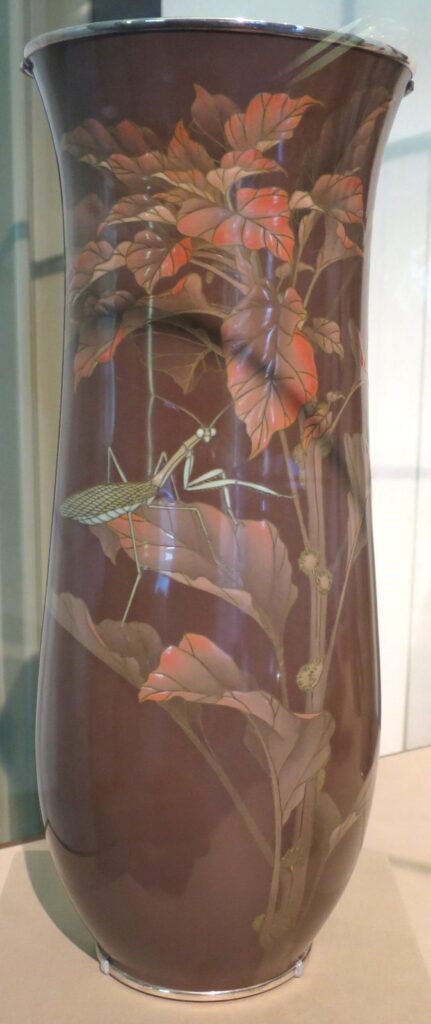
Reference · Private collection, per Wikimedia Commons Hattori Tadasaburō, Vase with praying mantis amid foliage, private collection (per Wikimedia Commons). CC0. Source ↗

Biography
Short entry. Open, citable sources for this maker are limited, so we have published only what we can source. It will be extended as research continues.
Hattori Tadasaburō was a Nagoya cloisonné artist. With Kawade Shibatarō he developed the moriage, or “piling up”, technique, in which layers of enamel build a three-dimensional effect. His work is in the Victoria and Albert Museum and the Khalili Collection.1
The V&A holds a pair of Nagoya vases of about 1900–10, marked Hattori, with low-relief moriage egrets. A Bonhams catalogue gives his death as 1939 and dates a large moriage vase by him to the Taishō era, about 1912–20. He does not appear on the list of Imperial Household Artists.234
Chronology 年譜
No dated events can be sourced yet.
At auction 落札作品
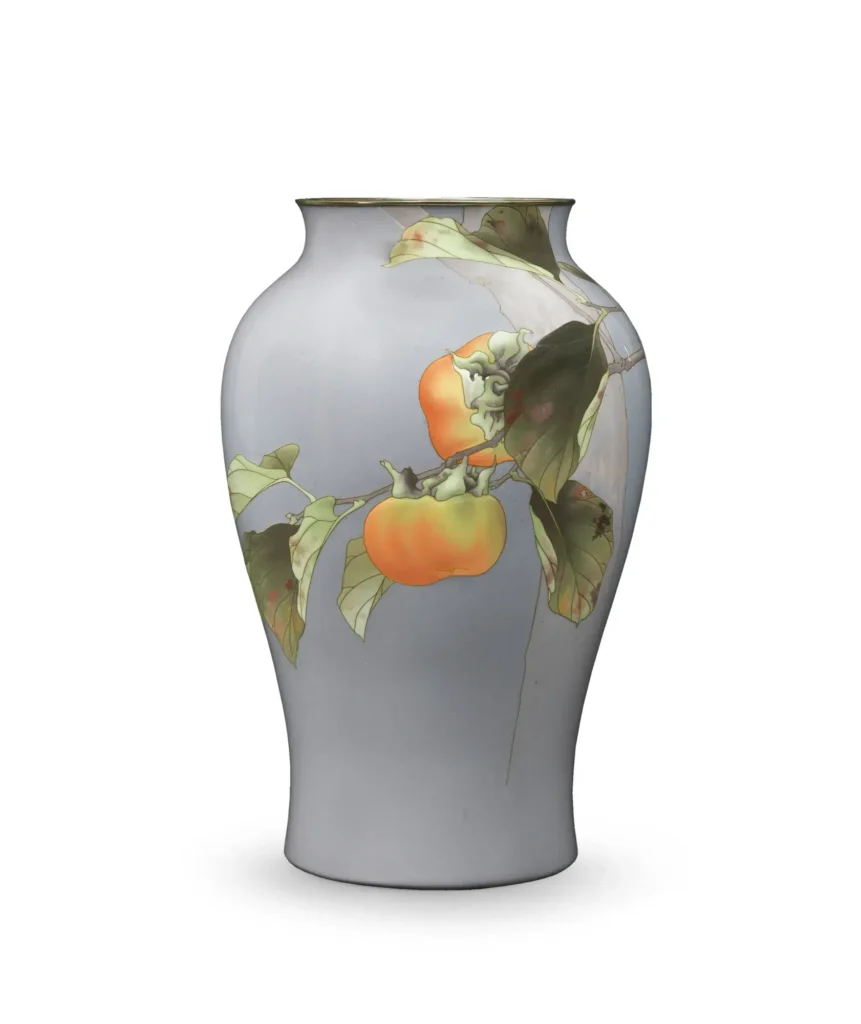
Our auction-records database holds 1 public result for this maker, at Bonhams, from 2018 to 2018. The highest is an exceptionally fine baluster moriage cloisonné-enamel vase, Bonhams, Fine Japanese Art, 2018-05-17, lot 515, at £100,000 (about US$135,150 at the sale-date rate). These are public historical results, not valuations.
Bonhams catalogues a baluster vase sold in 2018 as by Hattori Tadasaburō and worked in moriage (raised) cloisonné with fruiting branches.1
Christie’s sold in 2007 a vase signed Hattori Kin sei, worked in gold wire and moriage on a celadon ground with two imperial mon, and catalogued it as an imperial presentation piece. We record the signature as catalogued and do not assume that it names the same hand.2
Facts in this section are as stated by the auction houses in their lot essays, footnoted below. Where they differ from other sources we say so.
Works sold at auction
Photographs © the auction houses, as credited. Each links to its record.
Notes to “At auction”
Record prices 最高落札
Public historical auction results from our auction-records database, including buyer’s premium. They are not a valuation of any work.
| Date | Object, as catalogued | House | Result |
|---|---|---|---|
| 2018-05-17 | An exceptionally fine baluster moriage cloisonné-enamel vase By | Bonhams, lot 515 | £100,000 ≈ US$135,150 |
Other cited auction results
Public auction results, cited to the auction house record, including buyer’s premium unless stated, in the original currency. They are historical facts, not a valuation of any work offered.
No public auction results for this maker are recorded in our index yet.
Sources
Descriptions record our research and opinion as of 20 October 2026. Works are offered as described. Please see our Terms of Sale.