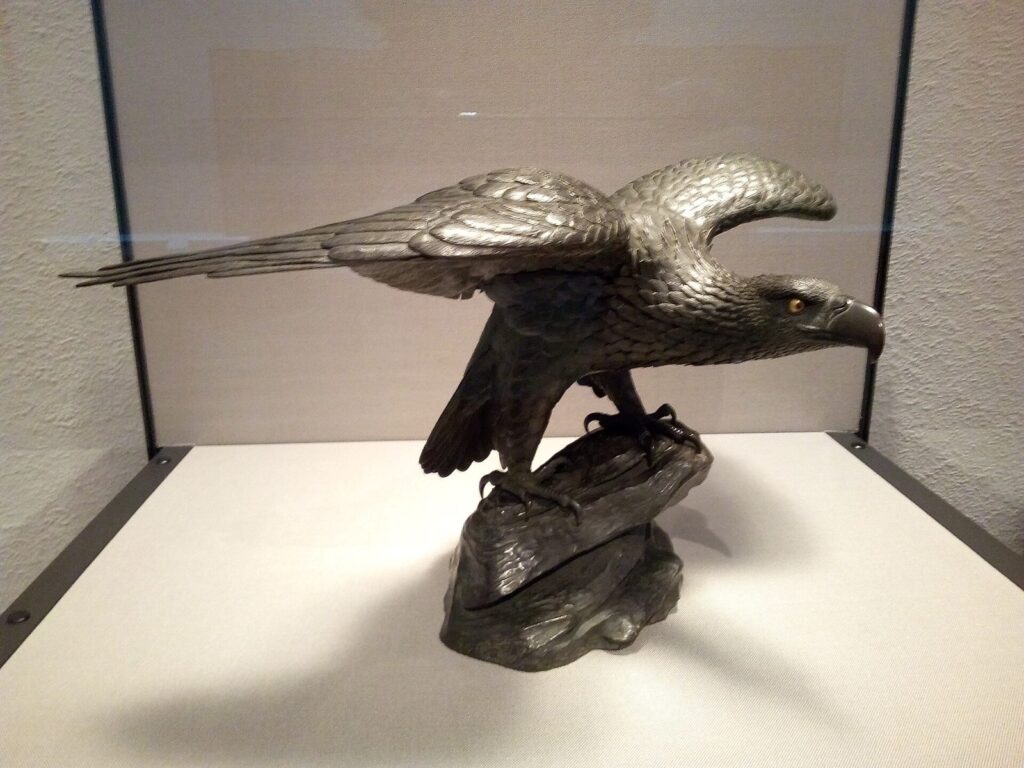
Reference · Tokyo National Museum Eagle (Suzuki Chokichi). CC BY-SA 4.0 (by Myshkin.). Source ↗
I · Identification & Maker
Maker: Suzuki Chokichi · 鈴木長吉
Date / period: 1892
Collection / last record: Tokyo National Museum E-13034, Important Cultural Property
II · Technical Masterwork Criteria
Bronze
Teishitsu Gigeiin: Teishitsu Gigeiin 30 Jun 1896 (en.wikipedia.org · Imperial Household Artist ↗)
Exposition / provenance: Gift of the Japan Delegate Office, Chicago Expo
III · Iconography & Cultural Meaning (interpretive)
eagle: washi, power; a favourite Western export subject
Philosophical context (INTERPRETIVE, except the sourced Haitorei fact). The 1876 Haitorei decree banned samurai from wearing swords in public, depriving sword-fitting artisans of their market, so many turned to export art (sourced: antiquesandthearts.com · samurai to the imperial court japanese metalwork ↗). Meiji export pieces often favour dense, virtuosic surface (horror vacui for Western taste), in tension with native ideals of yugen (subtle depth), wabi-sabi (imperfect, transient beauty) and shibui (restrained elegance). The finest makers (Meizan's negative space, Yasuyuki's monochrome grounds, Seifu's celadons) reconcile the two.
IV · Marks 落款 & box
Mark / seal as published: —
Tomobako: n/a
Sources:
Assessment
See how we score
| Maker stature | 2.5 / 2.5 |
| Recognition (museum / designation / price) | 3 / 3 |
| Exhibition | 1 / 1 |
| Technique (cited) | 1 / 1.5 |
| Provenance | 1 / 1 |
| Condition, scale & documentation | 0.5 / 1 |
| Total | 9 / 10 |
Reasoning: Gigeiin; ICP; TNM; Chicago exposition provenance. How we score.
Maker context
Suzuki Chōkichi, whose art name was Kakō, was born on 12 September 1848 at Ishii in Musashi Province, in present-day Sakado, Saitama. He studied wax-model casting for five years with Okano Tōryūsai and set up on his own in Edo at eighteen.
In 1874 he became supervisor of the casting department of the Kiryū Kōshō Kaisha, the government-backed company set up to export Japanese crafts, and later its head of works. He left the company in 1882. During those years he made large works for exhibitions at home and abroad. The V&A’s bronze incense burner with a peacock and peahen, 228.6 cm high and signed Dai Nihon Kakō sei, was shown on the company’s stand at the Paris Exposition Universelle of 1878. It was bought from Siegfried Bing and registered by the museum in 1883.123
Summarised from our maker page, where every fact is footnoted: Suzuki Chōkichi 鈴木長吉.
Notes to “Maker context”
Related records

Descriptions record our research and opinion as of 20 October 2026. Works are offered as described. Please see our Terms of Sale.