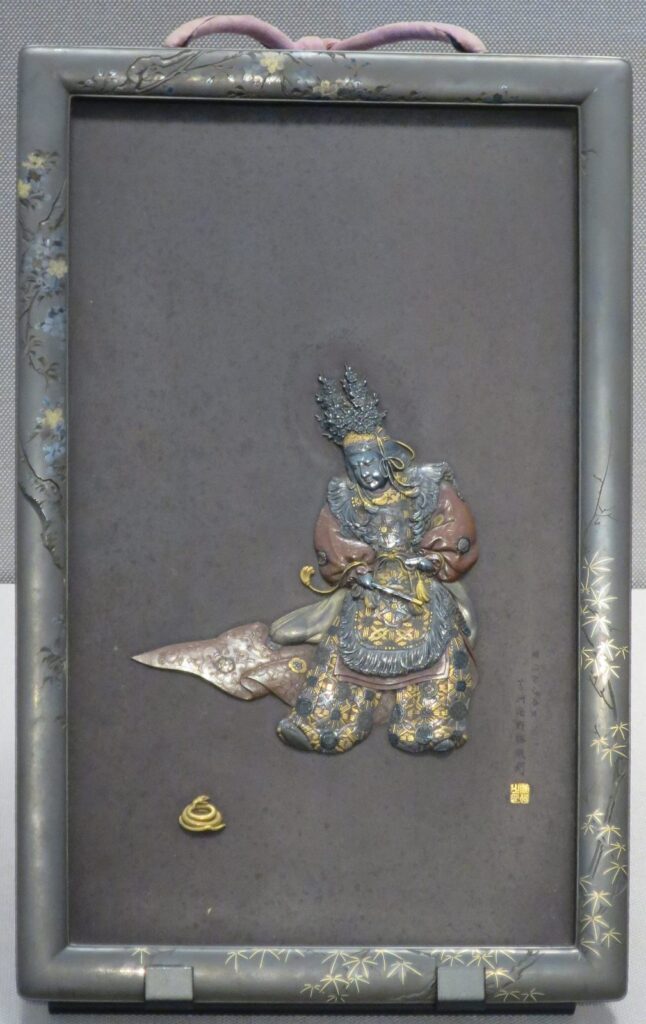
Reference · Tokyo National Museum Unno Shōmin, Plaque with a Scene of the Genjōraku Dance, 1893, Tokyo National Museum. CC0. Source ↗
I · Maker & date
Maker: Unno Shōmin (1844–1915)
Date: Meiji era, 1893 (dated on the plaque per the museum; the Commons file says 1892)
Collection: Tokyo National Museum E-12757
II · Technique
Iron plate with raised inlay in gold, silver, copper and their alloys. The intricately carved design depicts a bugaku dancer before a coiled snake.
III · Exhibition & provenance
Displayed at the World’s Columbian Exposition, Chicago, 1893. Gift of the Japanese Delegate’s Office for the Exposition to the Tokyo National Museum.
IV · Marks
Engraved at lower right with the artist’s name and a date the museum translates as 1893 A.D.
Sources: ColBase, Tokyo National Museum E-12757 ↗ · Wikimedia Commons file (CC0) ↗ · Imperial Household Artist list, Japanese Wikipedia ↗
Assessment
See how we score
| Criterion | Score |
|---|---|
| Maker stature | 2.5 / 2.5 |
| Recognition (museum / designation / price) | 2.5 / 3 |
| Exhibition | 1 / 1 |
| Technique (cited) | 1.5 / 1.5 |
| Provenance | 1 / 1 |
| Condition, scale & documentation | 1 / 1 |
| Total | 9.5 / 10 |
Reasoning: Imperial Household Artist (1896); Tokyo National Museum; shown at Chicago 1893; gift of the Japanese Delegate’s Office; signed and dated. How we score.
Maker context
Unno Shōmin was born at Mito on 30 June 1844, the fourth son of Den’emon. He learned metal carving from his uncle, the first Unno Moritoshi, and then from Hagiya Katsuhira of the Mito domain. He also studied painting and Chinese texts.
He moved to Tokyo early in the Meiji era and opened his workshop at Komagome Sendagi in 1876. He received honourable mentions at the National Industrial Exhibitions of 1877 and 1881. In 1890 his figure of Ryōōō won a first prize for technical excellence at the third exhibition. That work, now in the Museum of the Imperial Collections, was designated an Important Cultural Property in 2022.1
Summarised from our maker page, where every fact is footnoted: Unno Shōmin 海野勝珉.
Notes to “Maker context”
- 海野勝珉, Japanese Wikipedia ↗
Related records

Descriptions record our research and opinion as of 20 October 2026. Works are offered as described. Please see our Terms of Sale.