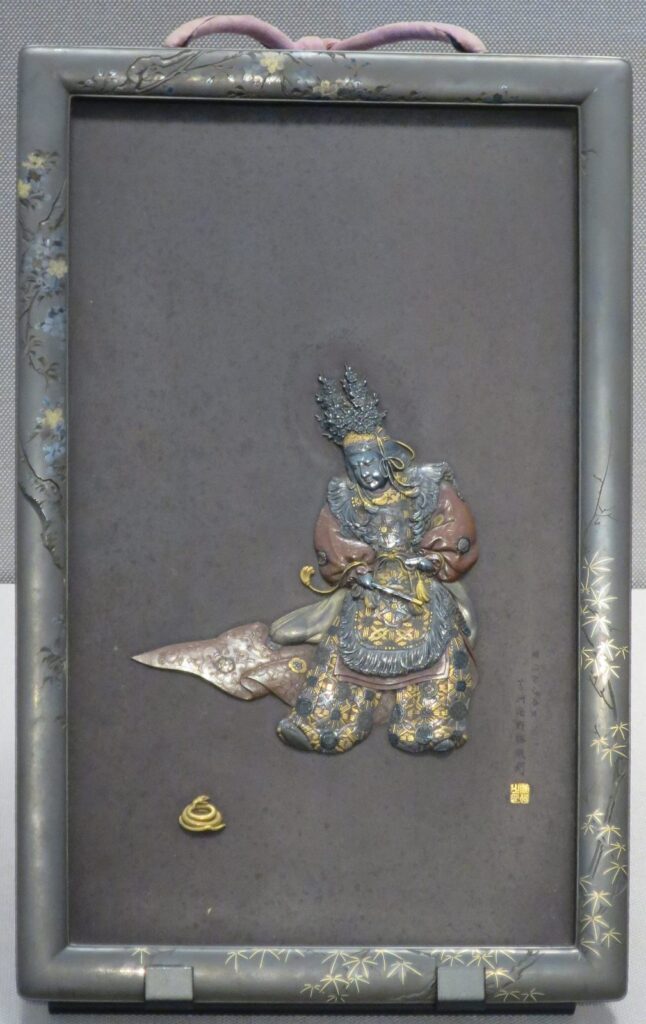
Reference Unno Shōmin, Plaque with a Scene of the Genjōraku Dance, 1893, Tokyo National Museum. CC0. Source ↗

Biography
Unno Shōmin was born at Mito on 30 June 1844, the fourth son of Den’emon. He learned metal carving from his uncle, the first Unno Moritoshi, and then from Hagiya Katsuhira of the Mito domain. He also studied painting and Chinese texts.1
He moved to Tokyo early in the Meiji era and opened his workshop at Komagome Sendagi in 1876. He received honourable mentions at the National Industrial Exhibitions of 1877 and 1881. In 1890 his figure of Ryōōō won a first prize for technical excellence at the third exhibition. That work, now in the Museum of the Imperial Collections, was designated an Important Cultural Property in 2022.1
In 1891 he became an assistant professor at the Tokyo School of Fine Arts, where he studied further under Kanō Natsuo, and he became a professor in 1894. He was a judge at the fourth exhibition in 1895 and was appointed an Imperial Household Artist on 30 June 1896. His plaque of the Genjōraku dance, dated 1893 and shown at Chicago that year, is in the Tokyo National Museum. His Taiheiraku figure was shown at Paris in 1900.132
Japanese Wikipedia notes his skill in katakiribori, chiselled engraving with an angled blade, and in inlay that combines many metals for colour. He died in October 1915.1
In 1903 he worked with the lacquerer Kawanobe Itchō and the designer Rokkaku Shisui on a bookshelf with chrysanthemums in maki-e and mother-of-pearl, now in the Museum of the Imperial Collections and designated an Important Cultural Property in 2024. His Taiheiraku figure was designated in the same year. He received the Order of the Sacred Treasure, sixth class, in 1905, following Kanō Natsuo. His third son, Unno Kiyoshi, later became a member of the Japan Art Academy and a Living National Treasure.1
Chronology 年譜
| Date | Event | Source |
|---|---|---|
| 1844 | Born at Mito. | 1 |
| 1876 | Opens his workshop in Tokyo. | 1 |
| 1877 | Honourable mention, first National Industrial Exhibition. | 1 |
| 1881 | Honourable mention, second exhibition. | 1 |
| 1890 | First prize for technical excellence (Ryōōō). | 1 |
| 1891 | Assistant professor, Tokyo School of Fine Arts. | 1 |
| 1893 | Genjōraku plaque shown at Chicago. | 2 |
| 1894 | Professor. | 1 |
| 1896 | Appointed Imperial Household Artist (30 June). | 3 |
| 1899 | Taiheiraku figure made; shown at Paris in 1900. | 1 |
| 1915 | Dies in October. | 1 |
Archive records
Works and signatures at auction 落款
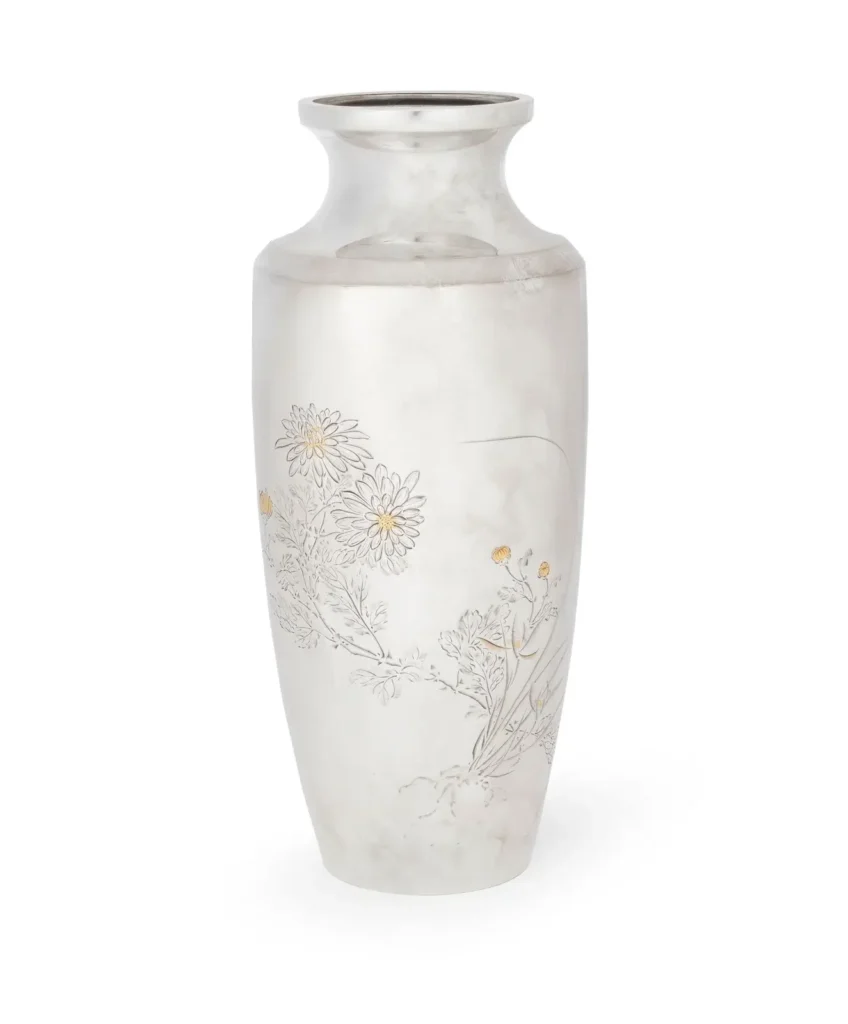
Auction catalogues show the forms his signature takes. A silver baluster vase sold at Bonhams in London in 2014, 36.5 cm high, is carved with two stalks of flowering chrysanthemum in katakiri-bori (angled-chisel carving) and kebori (line engraving), with small details inlaid in gold (honzōgan). It is signed on the side in chiselled characters Hōshūsō Shōmin with a kaō (cursive monogram), the base is stamped with two seals, and it came with a wood storage box. It sold for £4,000.1
A fan-shaped panel of Fukurokuju, one of the Seven Lucky Gods, sold at Christie’s in London in 2016 for £11,250, is carved, chiselled and inlaid in gold and signed Hōshō sō Shōmin with kaō. A saleroom notice specified that the metal is the alloy shibuichi.2 A pair of small ojime (cord beads) sold in New York in 2017, one signed Shōmin and one sealed Shō, came in a box inscribed by his son Unno Kiyoshi (1884–1956) and dated 1928.3
Notes to “Works and signatures at auction”
- Bonhams, Fine Japanese Art, London, 15 May 2014, lot 556, lot description. ↗
- Christie’s, Art of Japan, London, 8 December 2016, lot description and saleroom notice (lot 6047677). ↗
- Christie’s, An Inquiring Mind: American Collecting of Japanese & Korean Art, New York, 25 April 2017, lot description (lot 6067701). ↗
Public auction results
Public auction results, cited to the auction house record, including buyer’s premium unless stated, in the original currency. They are historical facts, not a valuation of any work offered.
| Year | Object, as catalogued | Result | Source |
|---|---|---|---|
| 2014 | Unno Shomin: Silver baluster vase, chrysanthemums, 36.5 cm. Bonhams London 15 May 2014 | £4,000 | Source ↗ |
| 2016 | Unno Shomin (1844–1915): Soft-metal fan-shaped panel of Fukurokuju, 39 cm. Christie's London 8 Dec 2016 | GBP 11,250 | Source ↗ |
| 2017 | Unno Shomin: Two ojime (shibuichi inlaid; gold carved lotus). Christie's NY 25 Apr 2017 | US$4,000 | Source ↗ |
Sources
Descriptions record our research and opinion as of 20 October 2026. Works are offered as described. Please see our Terms of Sale.