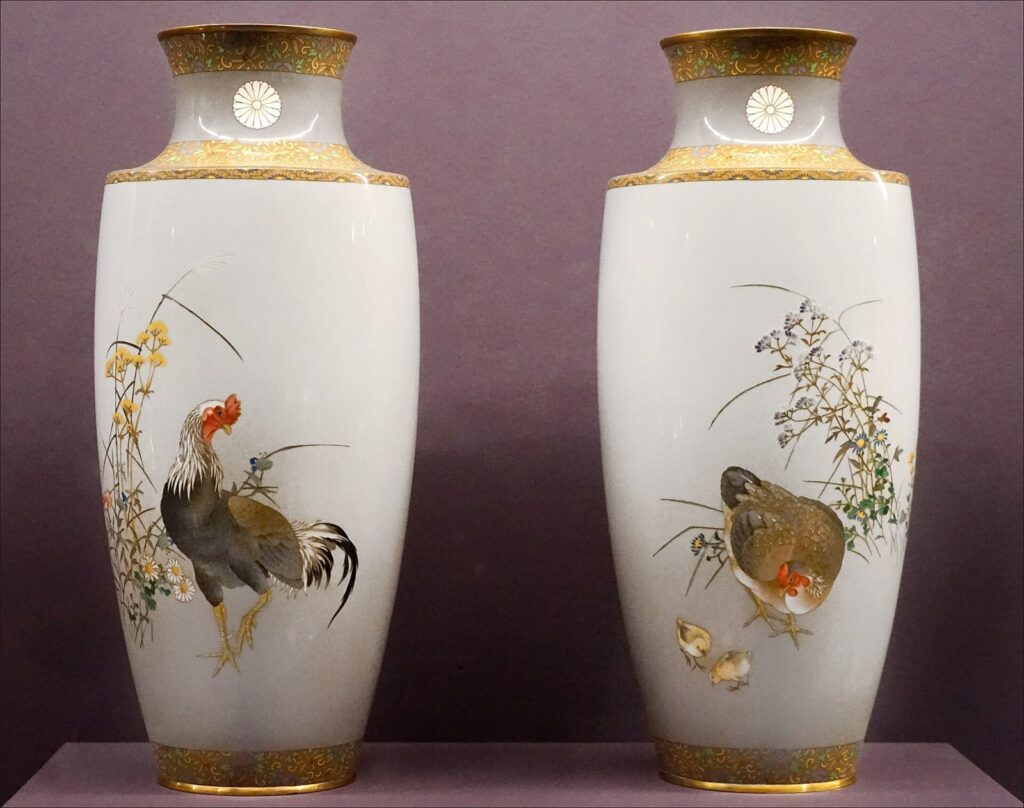
Reference · Musée Guimet Namikawa Sōsuke, vases, Musée Guimet, Paris (photograph by Jean-Pierre Dalbéra). CC BY 2.0. Source ↗

Biography
Namikawa Sōsuke was born in 1847 in Shimōsa Province, in present-day Asahi, Chiba. He was the second son of a farming family, and he became a merchant dealing in ceramics. In 1877 he visited the first National Industrial Exhibition and turned to cloisonné. That same year he bought the Ahrens & Co. cloisonné works at Kameido in Tokyo, which employed Owari craftsmen. In 1887 he also bought the Tokyo branch of the Nagoya cloisonné company.2
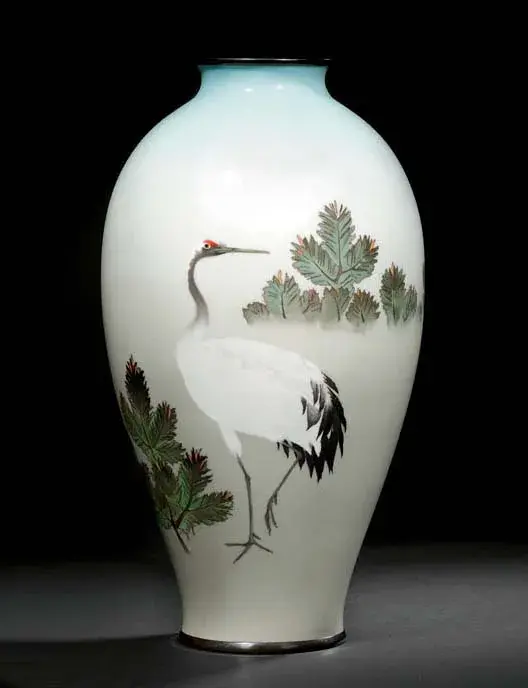
His name is linked above all with musen (wireless) cloisonné. In this technique the wires that separate the colours are removed before the final firing, so the colours can meet in soft gradations. Japanese Wikipedia dates his invention of the method to 1879. The English article adds that Gottfried Wagener helped develop it, but that Namikawa later took credit for it. He also used shōsen, in which most of the wire is removed and only fine detail is left. With these techniques his enamels could resemble paintings. He often reproduced designs by the nihonga painter Watanabe Seitei.21
He won an honorary gold medal at the 1881 National Industrial Exhibition. He won awards at Amsterdam and Nuremberg in 1885 and at Paris in 1889. He showed at Chicago in 1893, won a Grand Prize at St Louis in 1904, and was represented at the Japan–British Exhibition of 1910. His Mount Fuji plaque, shown at Chicago in 1893, is in the Tokyo National Museum and was designated an Important Cultural Property in 2011.12
He was appointed an Imperial Household Artist on 30 June 1896. He received many commissions from the Imperial Household Ministry, among them thirty oval enamel plaques of flowers and birds after Watanabe Seitei for the Akasaka Palace, made in 1906–07. Japanese Wikipedia records that Namikawa Yasuyuki was also considered for that commission. Sōsuke was chosen because his musen style suited the room. He died in February 1910.312
Chronology 年譜
| Date | Event | Source |
|---|---|---|
| 1847 | Born in Shimōsa Province. | 2 |
| 1877 | Turns to cloisonné; buys the Ahrens works at Kameido. | 2 |
| 1879 | Invention of musen cloisonné, as dated by Japanese Wikipedia. | 2 |
| 1881 | Honorary gold medal, second National Industrial Exhibition. | 2 |
| 1885 | Awards at Amsterdam and Nuremberg. | 1 |
| 1887 | Buys the Tokyo branch of the Nagoya cloisonné company. | 2 |
| 1889 | Award, Paris Exposition Universelle. | 1 |
| 1893 | Mount Fuji plaque shown at Chicago. | 2 |
| 1896 | Appointed Imperial Household Artist (30 June). | 3 |
| 1904 | Grand Prize, St Louis. | 1 |
| 1906–07 | Thirty plaques for the Akasaka Palace. | 1 |
| 1910 | Dies in February. | 2 |
Archive records
At auction 落札作品
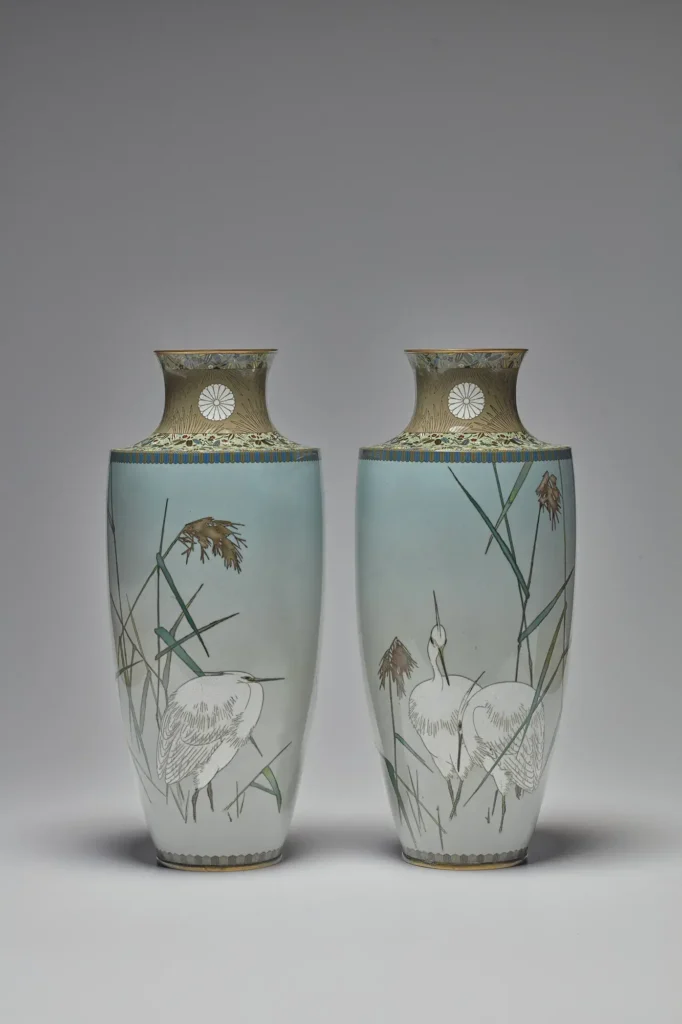
Our auction-records database holds 4 public results for this maker, at Bonhams and Christie’s, from 2007 to 2026. The highest is a pair of cloisonné enamel imperial presentation vases, Christie's, Japanese and Korean Art, 2020-09-22, lot 54, at US$237,500. These are public historical results, not valuations.
Bonhams’ 2017 essay calls Sōsuke “one of the greatest craft entrepreneurs of the later Meiji era” and describes his musen (wireless) technique as his most enduring contribution. It explains that improved enamel chemistry let colours adhere securely to the metal body, so that large unbroken areas of colour became possible, although wires between colours probably still had to be applied and removed at each stage.1
The essay records his appointment as Teishitsu Gigeiin in 1896 and the 32 panels for the Akasaka Rikyū Palace, completed in 1909. The site’s biography above, following Japanese Wikipedia, gives thirty plaques made in 1906–07; the sources differ and we report both.1
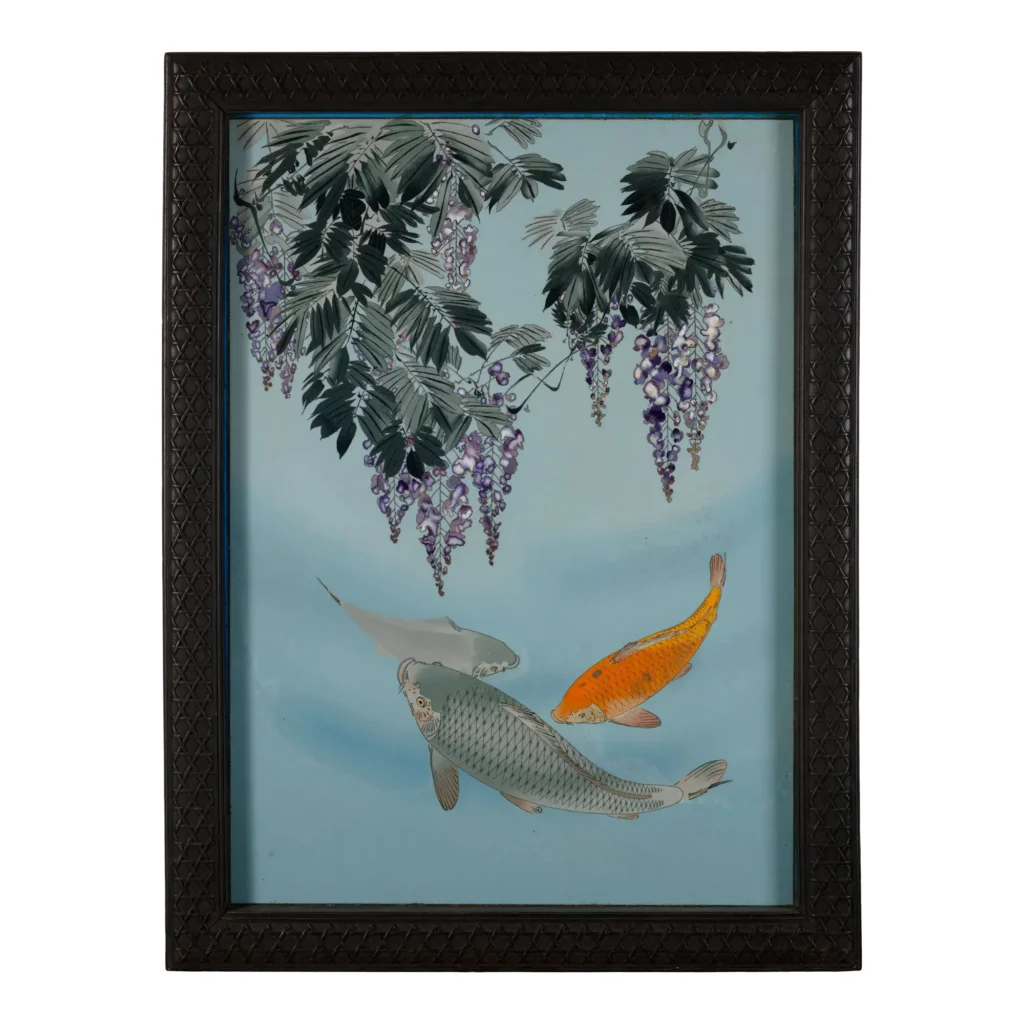
A plaque with carp sold in 2026 bears the mark of the Shippō Gaisha (Enamel Company) instead of the Sakigake character that, according to the cataloguer, Sōsuke began to apply to his works in about 1893; the company, the essay says, was taken over by Namikawa during the 1880s and moved from Nagoya to Tokyo.2
Facts in this section are as stated by the auction houses in their lot essays, footnoted below. Where they differ from other sources we say so.
Works sold at auction
Photographs © the auction houses, as credited. Each links to its record.
Notes to “At auction”
Record prices 最高落札
Public historical auction results from our auction-records database, including buyer’s premium. They are not a valuation of any work.
| Date | Object, as catalogued | House | Result |
|---|---|---|---|
| 2020-09-22 | A pair of cloisonné enamel imperial presentation vases Workshop of | Christie's, lot 54 | US$237,500 |
| 2026-09-16 | Massive Cloisonné-Enamel Plaque with Carp Company | Bonhams, lot 1003 | US$76,700 |
| 2017-11-09 | A fine pair of slender cloisonné-enamel baluster vases By | Bonhams, lot 209 | £50,000 ≈ US$65,610 |
| 2007-02-19 | A cloisonné vase By | Christie's, lot 214 | CHF 78,000 ≈ US$63,170 |
Other cited auction results
Public auction results, cited to the auction house record, including buyer’s premium unless stated, in the original currency. They are historical facts, not a valuation of any work offered.
| Year | Object, as catalogued | Result | Source |
|---|---|---|---|
| 2012 | Workshop of Namikawa Sosuke: Plaque. Christie's 11 Sep 2012 | US$22,500 | Source ↗ |
| 2026 | Namikawa Sosuke: Cloisonné and musen tray. Bonhams Knightsbridge 12 May 2026 | £21,760 | Source ↗ |
| 2026 | Workshop of Namikawa Sosuke (1847–1910): 'Egret' vase, 26 cm. Olympia Auctions 6 May 2026 | £37,500 (£30,000 hammer) | Source ↗ |
Sources
Descriptions record our research and opinion as of 20 October 2026. Works are offered as described. Please see our Terms of Sale.