I · Identification & Maker
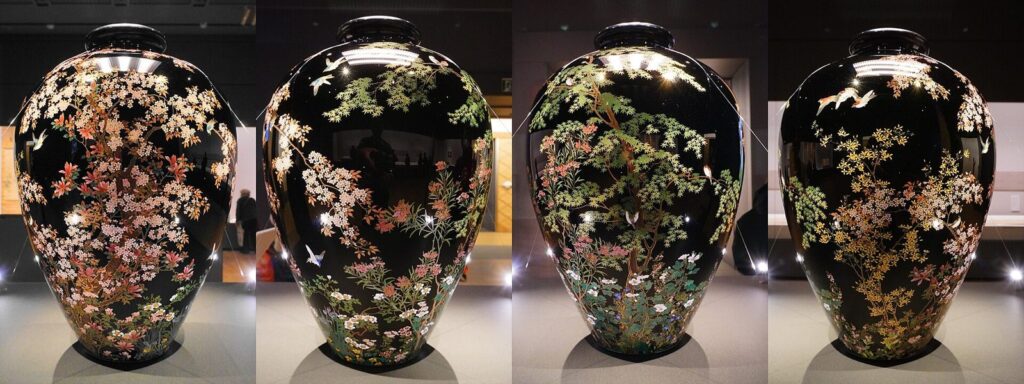
Maker: Namikawa Sosuke, after designs by Watanabe Seitei · kanji not yet sourced
Date / period: for the Togu Gosho (Crown Prince's Palace), completed 1909
Collection / last record: State Guest House, Akasaka Palace (in situ). The palace's main building was designated a National Treasure in 2009; the medallions are part of its interior: in situ · National Treasure building
II · Technical Masterwork Criteria
WIRE: not stated in the source. The enamelling reproduces nihonga shading and gradation and the medallions have been called masterpieces of Japanese cloisonné (Cabinet Office)
Teishitsu Gigeiin: Teishitsu Gigeiin 30 Jun 1896 (en.wikipedia.org · Imperial Household Artist ↗)
Exposition / provenance: Imperial commission for the Crown Prince's Palace
III · Iconography & Cultural Meaning (interpretive)
No motif decoded (subject not specific in source)
Philosophical context (INTERPRETIVE, except the sourced Haitorei fact). The 1876 Haitorei decree banned samurai from wearing swords in public, depriving sword-fitting artisans of their market, so many turned to export art (sourced: antiquesandthearts.com · samurai to the imperial court japanese metalwork ↗). Meiji export pieces often favour dense, virtuosic surface (horror vacui for Western taste), in tension with native ideals of yugen (subtle depth), wabi-sabi (imperfect, transient beauty) and shibui (restrained elegance). The finest makers (Meizan's negative space, Yasuyuki's monochrome grounds, Seifu's celadons) reconcile the two.
IV · Marks 落款 & box
Mark / seal as published: n/a
Tomobako: n/a
Sources: geihinkan.go.jp · kacho no ma ↗ · geihinkan.go.jp · kacho no ma ↗ · en.wikipedia.org · Akasaka Palace ↗
Assessment
See how we score
| Maker stature | 2.5 / 2.5 |
| Recognition (museum / designation / price) | 2.5 / 3 |
| Exhibition | 1 / 1 |
| Technique (cited) | 1.5 / 1.5 |
| Provenance | 1 / 1 |
| Condition, scale & documentation | 1 / 1 |
| Total | 9.5 / 10 |
Reasoning: Gigeiin maker after Watanabe Seitei; in situ in a National Treasure palace (the medallions are not separately designated); imperial commission; wire not stated. How we score.
Maker context
Namikawa Sōsuke was born in 1847 in Shimōsa Province, in present-day Asahi, Chiba. He was the second son of a farming family, and he became a merchant dealing in ceramics. In 1877 he visited the first National Industrial Exhibition and turned to cloisonné. That same year he bought the Ahrens & Co. cloisonné works at Kameido in Tokyo, which employed Owari craftsmen. In 1887 he also bought the Tokyo branch of the Nagoya cloisonné company.
His name is linked above all with musen (wireless) cloisonné. In this technique the wires that separate the colours are removed before the final firing, so the colours can meet in soft gradations. Japanese Wikipedia dates his invention of the method to 1879. The English article adds that Gottfried Wagener helped develop it, but that Namikawa later took credit for it. He also used shōsen, in which most of the wire is removed and only fine detail is left. With these techniques his enamels could resemble paintings. He often reproduced designs by the nihonga painter Watanabe Seitei.12
Summarised from our maker page, where every fact is footnoted: Namikawa Sōsuke 濤川惣助.
Notes to “Maker context”
Related records
Descriptions record our research and opinion as of 20 October 2026. Works are offered as described. Please see our Terms of Sale.