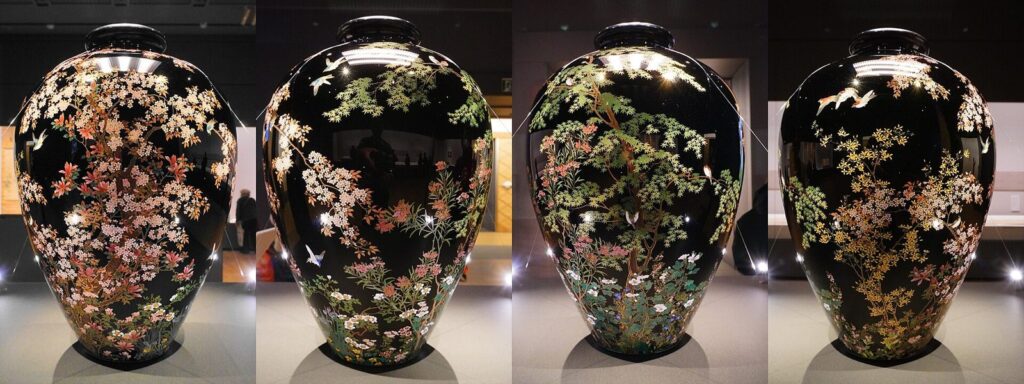
Reference · Museum of the Imperial Collections, Sannomaru Shozokan Vase with Birds and Flowers of the Four Seasons, Namikawa Yasuyuki, 1899, 四季花鳥図花瓶, 並河靖之. CC BY-SA 4.0 (by SLIMHANNYA). Source ↗

I · Identification & Maker
Maker: Namikawa Yasuyuki (1845–1927) · kanji not yet sourced
Date / period: 1899
Collection / last record: Museum of the Imperial Collections, Sannomaru Shozokan; Important Cultural Property (designated 26 Sep 2025): museum · Important Cultural Property
II · Technical Masterwork Criteria
WIRE: GOLD wire throughout, confirmed by XRF; shakudo mounts; flawless true-black ground; colour gradation within the wires (Agency for Cultural Affairs record). Among the largest Namikawa works
Teishitsu Gigeiin: Teishitsu Gigeiin 30 Jun 1896 (en.wikipedia.org · Imperial Household Artist ↗)
Exposition / provenance: Commissioned by the Imperial Household Ministry for the Paris Exposition 1900. Surviving underdrawings by Nakahara Tessen, the workshop's chief designer
III · Iconography & Cultural Meaning (interpretive)
No motif decoded (subject not specific in source)
Philosophical context (INTERPRETIVE, except the sourced Haitorei fact). The 1876 Haitorei decree banned samurai from wearing swords in public, depriving sword-fitting artisans of their market, so many turned to export art (sourced: antiquesandthearts.com · samurai to the imperial court japanese metalwork ↗). Meiji export pieces often favour dense, virtuosic surface (horror vacui for Western taste), in tension with native ideals of yugen (subtle depth), wabi-sabi (imperfect, transient beauty) and shibui (restrained elegance). The finest makers (Meizan's negative space, Yasuyuki's monochrome grounds, Seifu's celadons) reconcile the two.
IV · Marks 落款 & box
Mark / seal as published: Not captured from the source
Tomobako: Not captured
Sources: kunishitei.bunka.go.jp · 00012100 ↗ · online.bunka.go.jp · 668809 ↗ · tsumugu.yomiuri.co.jp · banpaku cultural assets paris 2505 ↗
Assessment
See how we score
| Maker stature | 2.5 / 2.5 |
| Recognition (museum / designation / price) | 3 / 3 |
| Exhibition | 1 / 1 |
| Technique (cited) | 1.5 / 1.5 |
| Provenance | 1 / 1 |
| Condition, scale & documentation | 1 / 1 |
| Total | 10 / 10 |
Reasoning: Gigeiin; ICP 2025; Paris 1900 imperial commission; gold wire by XRF; among the largest Namikawa works. How we score.
Maker context
Namikawa Yasuyuki was born in 1845 into a family whose original name was Takaoka, and he served as a samurai before taking up cloisonné around 1868. From 1871 to 1874 he worked for the Kyoto Cloisonné Company, and he later set up his own workshop in Kyoto. He sometimes signed his work Kyoto Namikawa.
His workshop was also a place visitors came to see. He began the tour in his garden, as an introduction to Japanese taste, and then showed each stage of production, including a sequence of fourteen polishing stones of graded roughness. Rudyard Kipling was among those who visited.1
Summarised from our maker page, where every fact is footnoted: Namikawa Yasuyuki 並河靖之.
Notes to “Maker context”
- Namikawa Yasuyuki, English Wikipedia ↗
Related records
Descriptions record our research and opinion as of 20 October 2026. Works are offered as described. Please see our Terms of Sale.