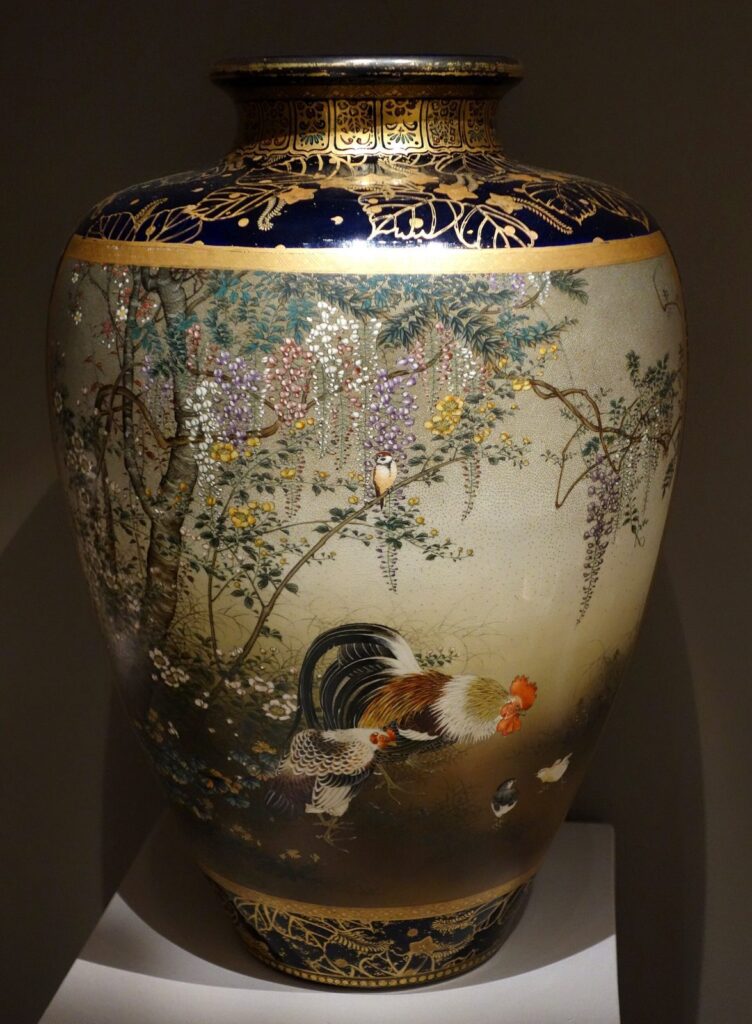
Reference · Chazen Museum of Art Large vase, Kinkōzan workshop, Kyoto, 1870s–1920s, Chazen Museum of Art. CC0. Source ↗

Biography
Short entry. Open, citable sources for this maker are limited, so we have published only what we can source. It will be extended as research continues.
Kinkōzan was a line of potters at Awataguchi in Kyoto. Japanese Wikipedia says the first head opened the kiln in about 1645, the third took the name Kinkōzan, and from the sixth generation it became the family surname. The sixth head, Sōbei VI (1823–1884), turned to export after Japan opened to foreign trade.1
His son Sōbei VII (1868–1927) succeeded young. Under the Kinkōzan name he exported Kyo-Satsuma, Kyoto-style painting on Satsuma-type earthenware, as well as cloisonné on ceramic bodies. He helped found Kyoto’s ceramic testing institute and training school. English Wikipedia describes the Kinkōzan pottery as having exported heavily from 1875, especially to America, and calls it the largest single producer of Satsuma export ware.12
No Kinkōzan head appears on the list of Imperial Household Artists. The vase illustrated is catalogued by the Chazen Museum of Art as Kinkōzan workshop, 1870s–1920s.3
Chronology 年譜
Only 6 dates can be sourced so far.
| Date | Event | Source |
|---|---|---|
| c. 1645 | Kiln founded at Awataguchi, Kyoto. | 1 |
| 1823 | Sōbei VI born. | 1 |
| 1868 | Sōbei VII born. | 1 |
| 1875 | Heavy export begins, as dated by English Wikipedia. | 2 |
| 1884 | Sōbei VI dies. | 1 |
| 1927 | Sōbei VII dies; the pottery's active period ends. | 12 |
At auction 落札作品
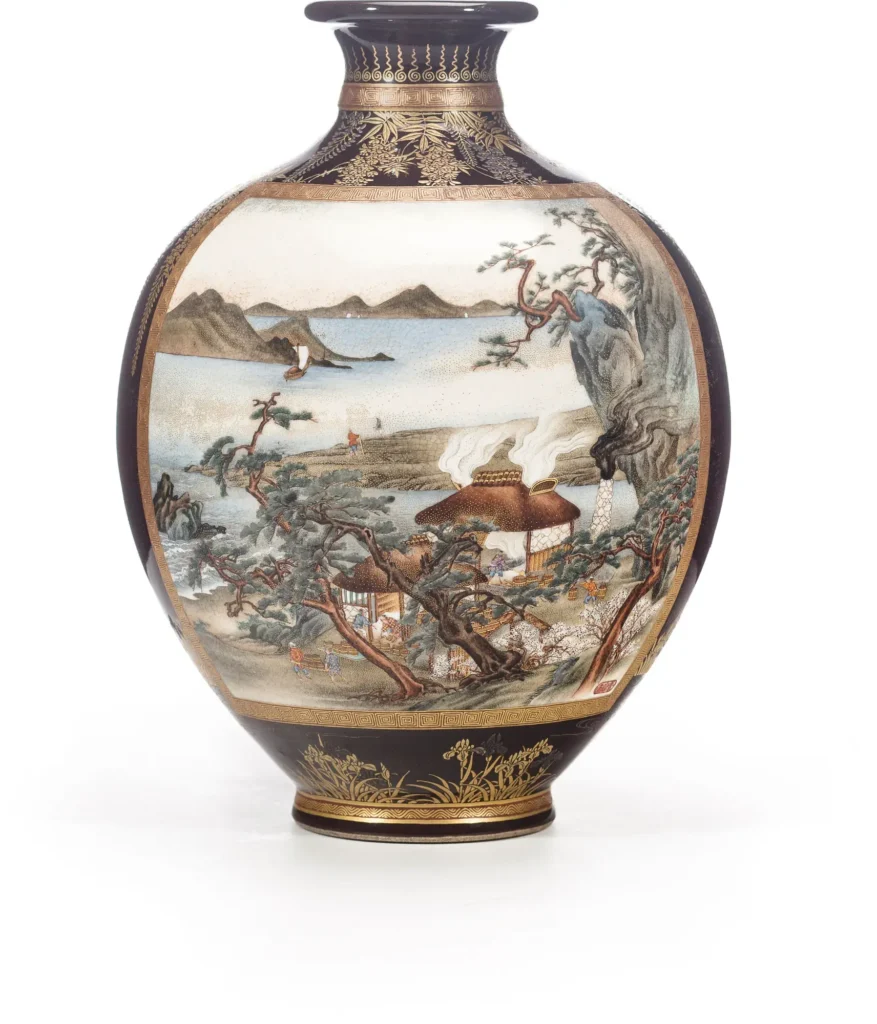
Our auction-records database holds 9 public results for this maker, at Bonhams and Christie’s, from 2007 to 2018. The highest is a fine Satsuma vase, Bonhams, Fine Japanese Works of Art, 2014-09-16, lot 2209, at US$56,250. These are public historical results, not valuations.
A Bonhams essay of 2018 identifies Kinkōzan Sōbei VII (1868–1928) as owner of the factory in its most productive period and records that he is thought to have exhibited first at Barcelona in 1888, then at Paris (1889), Chicago (1893), Paris (1900), St Louis (1904) and the Japan–British Exhibition in London (1910), as well as at Japan’s National Industrial Exhibitions. The essay gives his death as 1928; Japanese Wikipedia, cited above, gives 1927.1
The same essay notes that the factory’s most elaborate wares “fell out of favor with exhibition jurors from around 1900” while continuing to appeal to European and American buyers, and that Kinkōzan figural designs evoked the world of Prince Genji and medieval ink painting.1
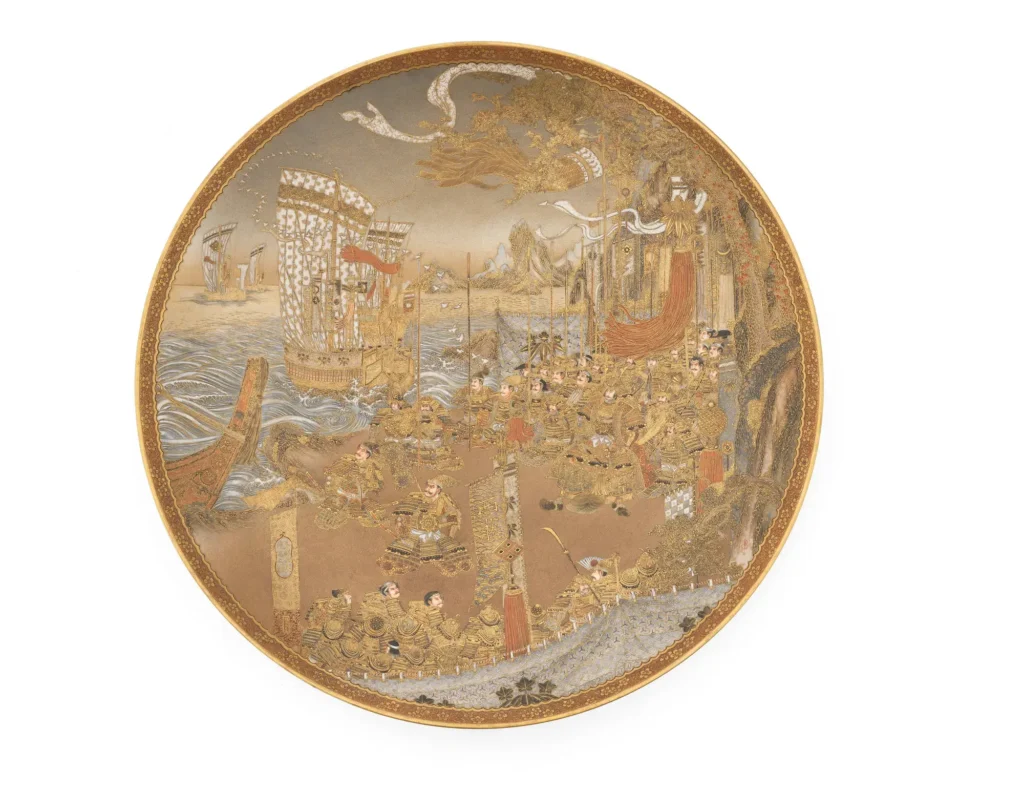
A charger painted by Sōzan for the Kinkōzan company, sold in 2014, takes its design of Yoshitsune crossing to Ezo from a triptych print by Utagawa Yoshitora published c. 1843–47, an instance of a print source identified by the cataloguer.2
Facts in this section are as stated by the auction houses in their lot essays, footnoted below. Where they differ from other sources we say so.
Works sold at auction
Photographs © the auction houses, as credited. Each links to its record.
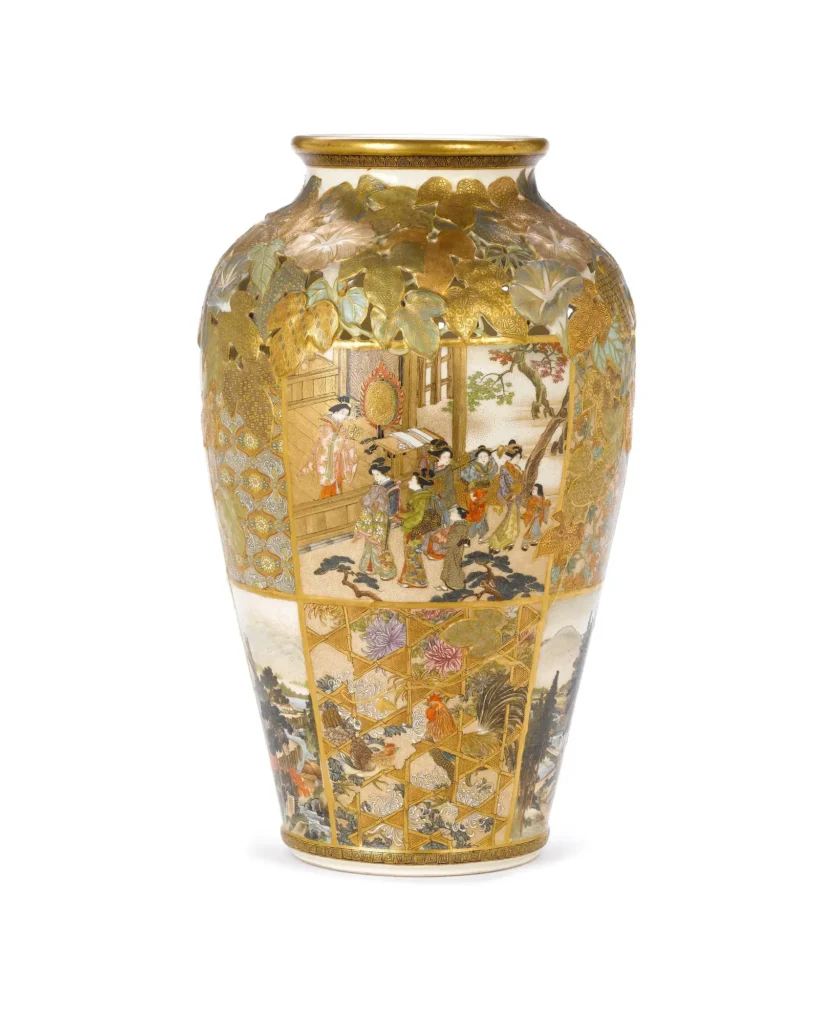
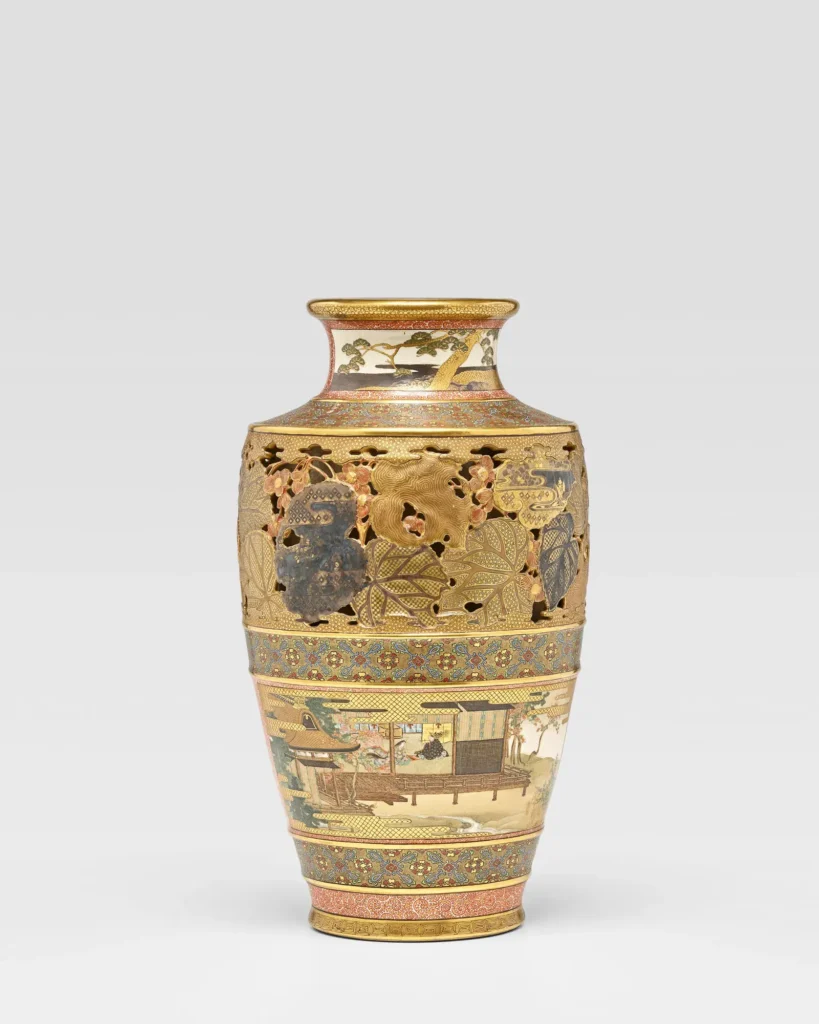
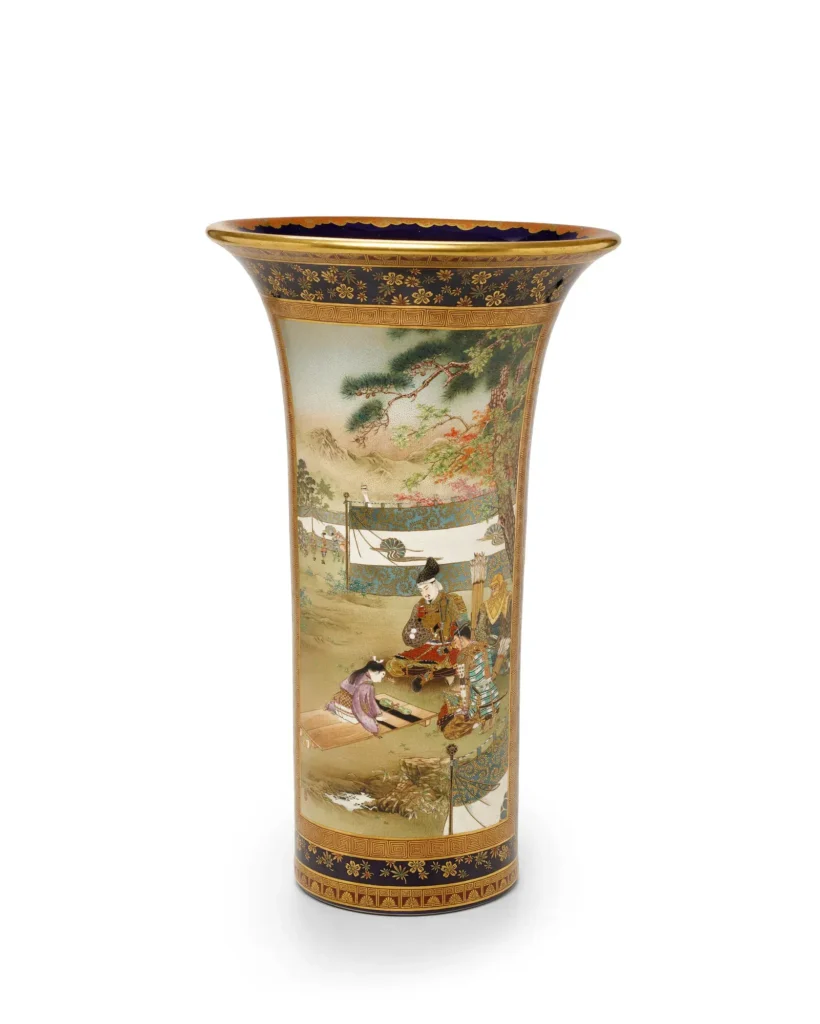
Notes to “At auction”
Record prices 最高落札
Public historical auction results from our auction-records database, including buyer’s premium. They are not a valuation of any work.
| Date | Object, as catalogued | House | Result |
|---|---|---|---|
| 2014-09-16 | A fine Satsuma vase Workshop of | Bonhams, lot 2209 | US$56,250 |
| 2007-02-19 | An impressive satsuma vase By | Christie's, lot 13 | CHF 66,000 ≈ US$53,451 |
| 2014-05-15 | A large Satsuma charger Company | Bonhams, lot 445 | £31,250 ≈ US$52,359 |
| 2010-11-11 | A fine and large Satsuma reticulated vase By | Bonhams, lot 265 | £31,200 ≈ US$50,341 |
| 2018-03-21 | A fine and rare reticulated Satsuma vase Workshop of | Bonhams, lot 2207 | US$50,000 |
| 2017-03-15 | A massive Satsuma trumpet vase Workshop of | Bonhams, lot 6263 | US$37,500 |
| 2014-09-16 | A rare green-ground Satsuma vase Workshop of | Bonhams, lot 2207 | US$35,000 |
| 2014-09-16 | A tall and fine Satsuma vase Workshop of | Bonhams, lot 2208 | US$35,000 |
| 2014-09-16 | A Satsuma vase Workshop of | Bonhams, lot 2220 | US$35,000 |
Other cited auction results
Public auction results, cited to the auction house record, including buyer’s premium unless stated, in the original currency. They are historical facts, not a valuation of any work offered.
| Year | Object, as catalogued | Result | Source |
|---|---|---|---|
| 2008 | Kinkozan: Koro and cover, wedding procession, 49 cm. Bonhams London 12 Nov 2008 | £3,600 | Source ↗ |
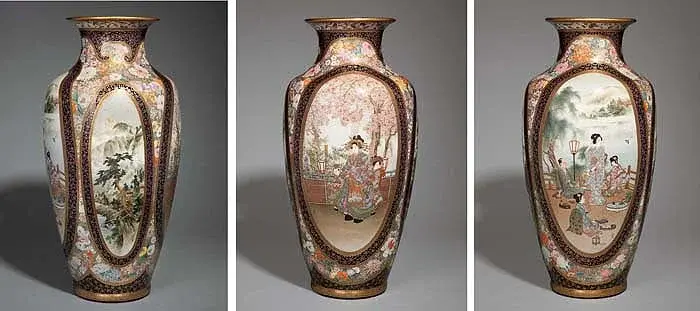
| 2016 | Kinkozan: Large four-sided vase, maple-viewing scene, 48 cm. Bonhams London 10 Nov 2016 | £9,375 | Source ↗ |
| 2017 | Sozan for the Kinkozan studio: Massive trumpet vase, Kusunoki Masashige farewell, 39 cm. Bonhams NY 15 Mar 2017 | US$37,500 | Source ↗ |
| 2026 | Kinkozan: Ovoid vase, three figural panels with Mt Fuji, 32 cm. Bonhams Knightsbridge 12 May 2026 | £7,680 | Source ↗ |
Sources
Descriptions record our research and opinion as of 20 October 2026. Works are offered as described. Please see our Terms of Sale.