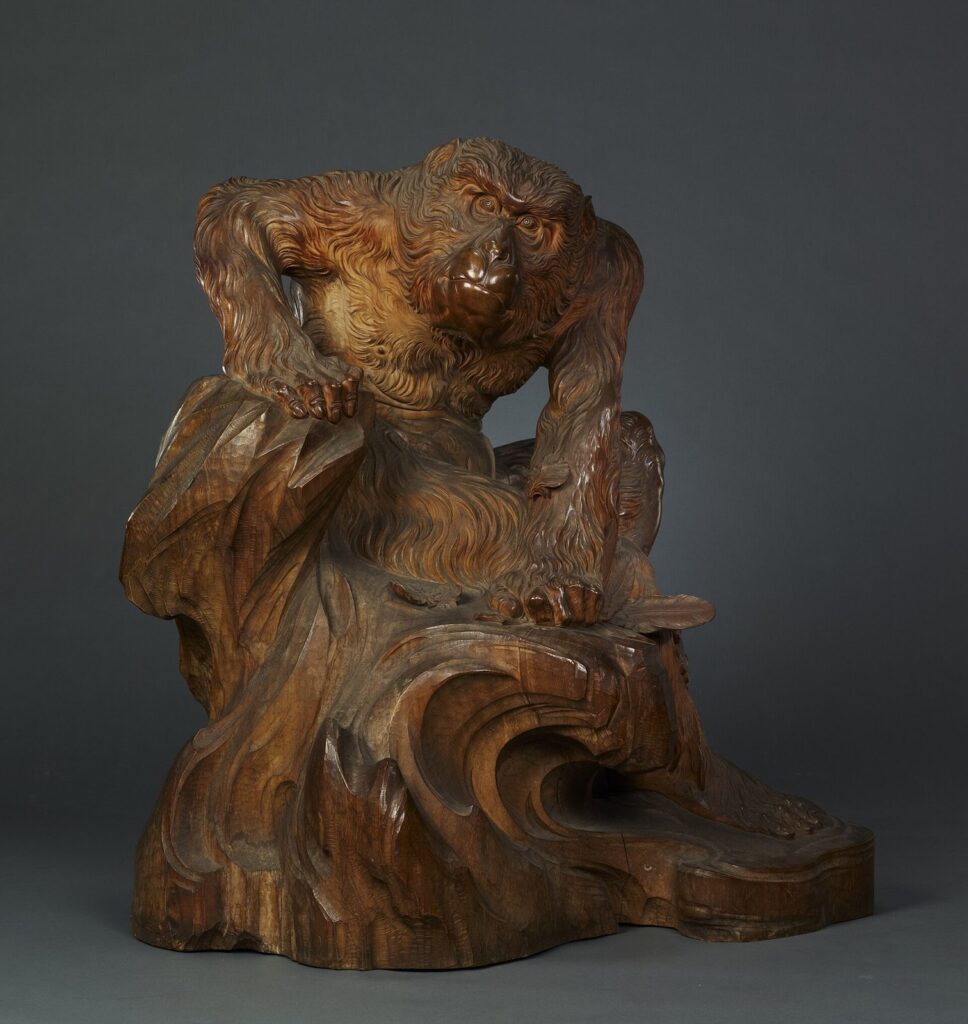
Reference · Tokyo National Museum Takamura Kōun, Old Monkey, 1893, Tokyo National Museum. CC BY 4.0. Source ↗

I · Maker & date
Maker: Takamura Kōun (1852–1934)
Date: Meiji era, 1893
Collection: Tokyo National Museum C-232; Important Cultural Property
II · Technique
Wood. The museum records that the sculptor recalled carving it from Japanese horse chestnut that had turned reddish brown with age, working from a live monkey borrowed from an acquaintance.
III · Exhibition & provenance
Exhibited at the World’s Columbian Exposition, Chicago, 1893, where it won an award. Gift of the Japan Delegate Office for the Exposition to the Tokyo National Museum.
IV · Marks
Assessment
See how we score
| Criterion | Score |
|---|---|
| Maker stature | 2.5 / 2.5 |
| Recognition (museum / designation / price) | 3 / 3 |
| Exhibition | 1 / 1 |
| Technique (cited) | 1.5 / 1.5 |
| Provenance | 1 / 1 |
| Condition, scale & documentation | 1 / 1 |
| Total | 10 / 10 |
Reasoning: Imperial Household Artist (1890); Important Cultural Property; shown at Chicago 1893 and won an award there; gift of the Japan Delegate Office. How we score.
About the maker
Takamura Kōun (1852–1934) was born in Tokyo as Nakajima Kōzō and studied under the Buddhist sculptor Takamura Tōun, whose elder sister became his adoptive parent. He became a professor at the Tokyo School of Fine Arts and worked for the modernisation of wood carving. His best-known public works are the bronze statue of Saigō Takamori in Ueno Park, completed in 1898, and the statue of Kusunoki Masashige outside the Imperial Palace. English Wikipedia names Old Monkey (Rōen) among his representative works. He was the father of the poet and sculptor Takamura Kōtarō.1
He was among the first group of Imperial Household Artists, appointed on 2 October 1890.2
Notes to “About the maker”
Related records
Descriptions record our research and opinion as of 20 October 2026. Works are offered as described. Please see our Terms of Sale.