Journal · Essay
Satsuma for export: Kyoto studios and the Yabu Meizan workshop
“Satsuma” in the Meiji export trade meant something quite different from the stoneware of Kagoshima. It meant cream-glazed earthenware painted in enamels and gold, much of it decorated in Kyoto and Osaka for buyers in Europe and America. This essay follows two of the businesses that defined the style, the Kinkōzan pottery of Kyoto and the Osaka studio of Yabu Meizan, using museum records, the standard reference articles and the lot essays of the auction houses.
A name that travelled
English Wikipedia notes that the term Satsuma ware spread from fine painted wares to include low-quality pieces mass-produced for export.1 The same article lists among the prominent makers of the Meiji and Taishō periods several of the Kyoto and Osaka names that appear in our database. The style was therefore not tied to a single kiln or place. It was a way of decorating an earthenware body, and studios far from Satsuma practised it.
Kinkōzan: an Awata kiln turns to export
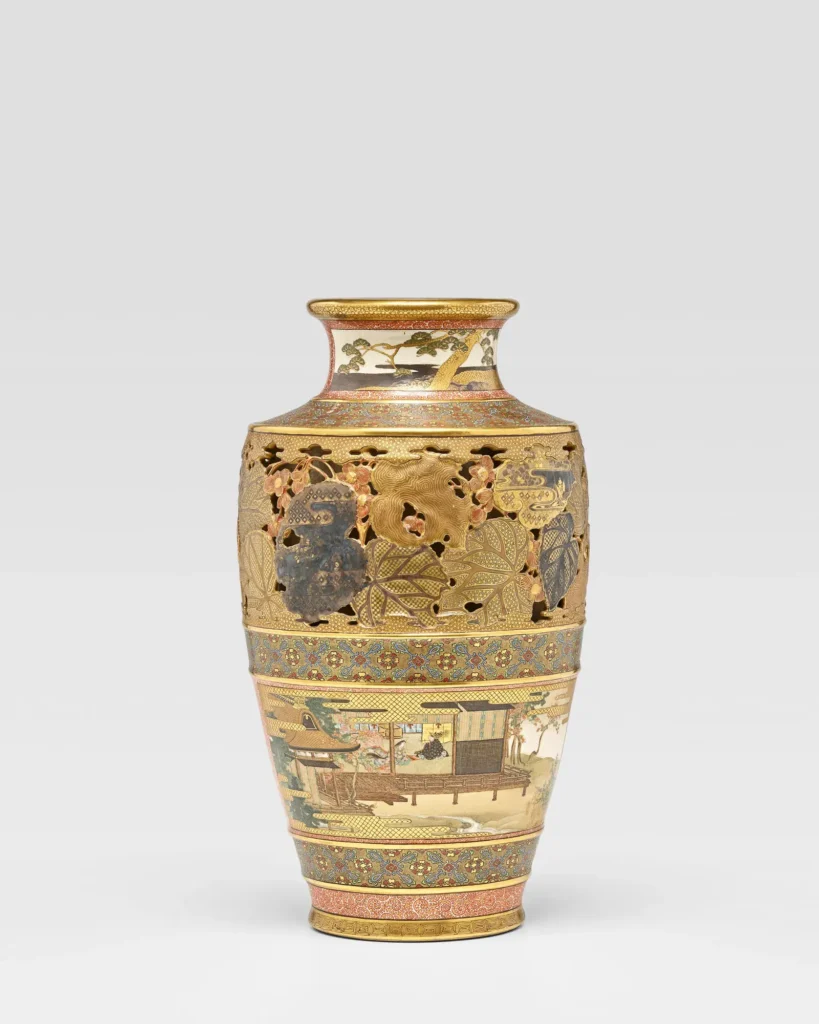
Kinkōzan was a line of potters at Awataguchi in Kyoto. Japanese Wikipedia records that the first head opened the kiln in about 1645, that the third took the name Kinkōzan, and that from the sixth generation it became the family surname. Sōbei VI (1823–1884) turned to export after Japan opened to foreign trade. His son Sōbei VII succeeded young, exported Kyo-Satsuma and cloisonné on ceramic bodies under the Kinkōzan name, and helped found Kyoto’s ceramic testing institute and training school.2 English Wikipedia describes the pottery as having exported heavily from 1875, especially to America, and calls it the largest single producer of Satsuma export ware.1
A Bonhams essay of 2018 adds an exhibition history. Sōbei VII, it says, is thought to have exhibited first at Barcelona in 1888, and then at Paris (1889), Chicago (1893), Paris (1900), St Louis (1904) and the Japan–British Exhibition in London (1910), as well as at Japan’s National Industrial Exhibitions. The essay gives his dates as 1868–1928, where Japanese Wikipedia gives 1927 for his death. We note the difference and do not resolve it.3
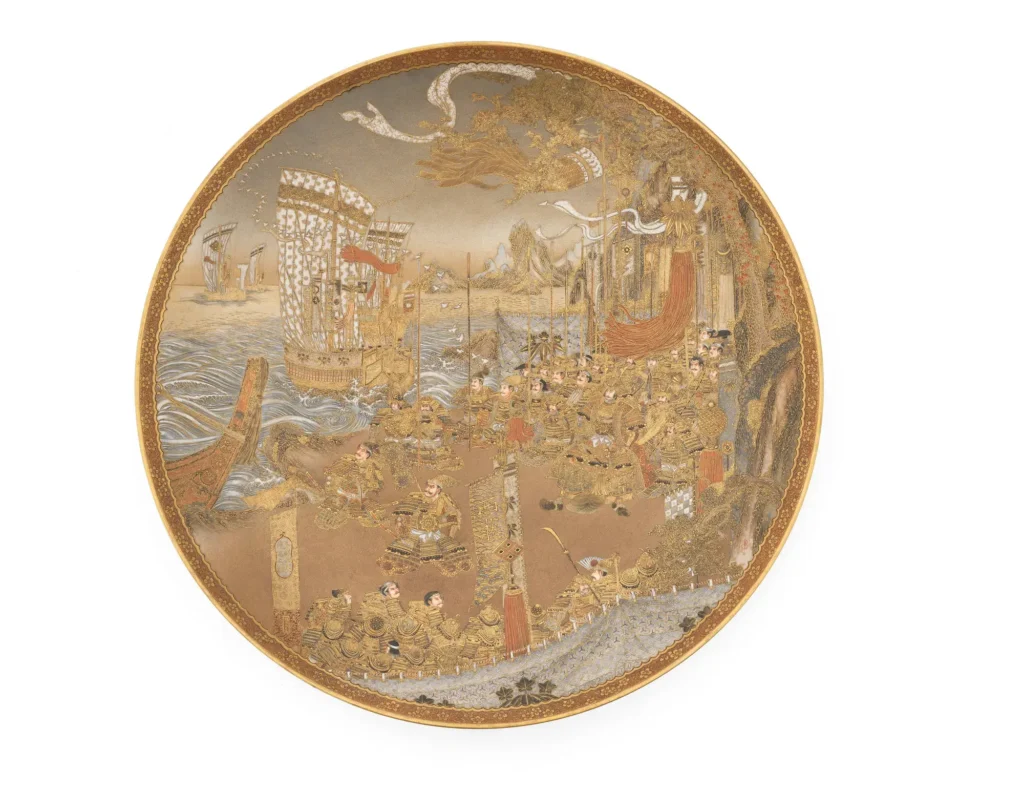
The same essay makes a point about taste: the factory’s most elaborate wares “fell out of favor with exhibition jurors from around 1900”, yet they continued to appeal to European and American buyers. In response, Kinkōzan’s figural designs evoked Japan’s past through scenes from the world of Prince Genji or “convincing evocations of medieval ink painting”.3 Painters within the firm sometimes signed their work. A charger sold in 2014 is catalogued as painted by Sōzan for the Kinkōzan company, and its scene of Yoshitsune crossing to Ezo is traced by the cataloguer to a triptych print by Utagawa Yoshitora published around 1843–47.4
Yabu Meizan: a decorating studio in Osaka
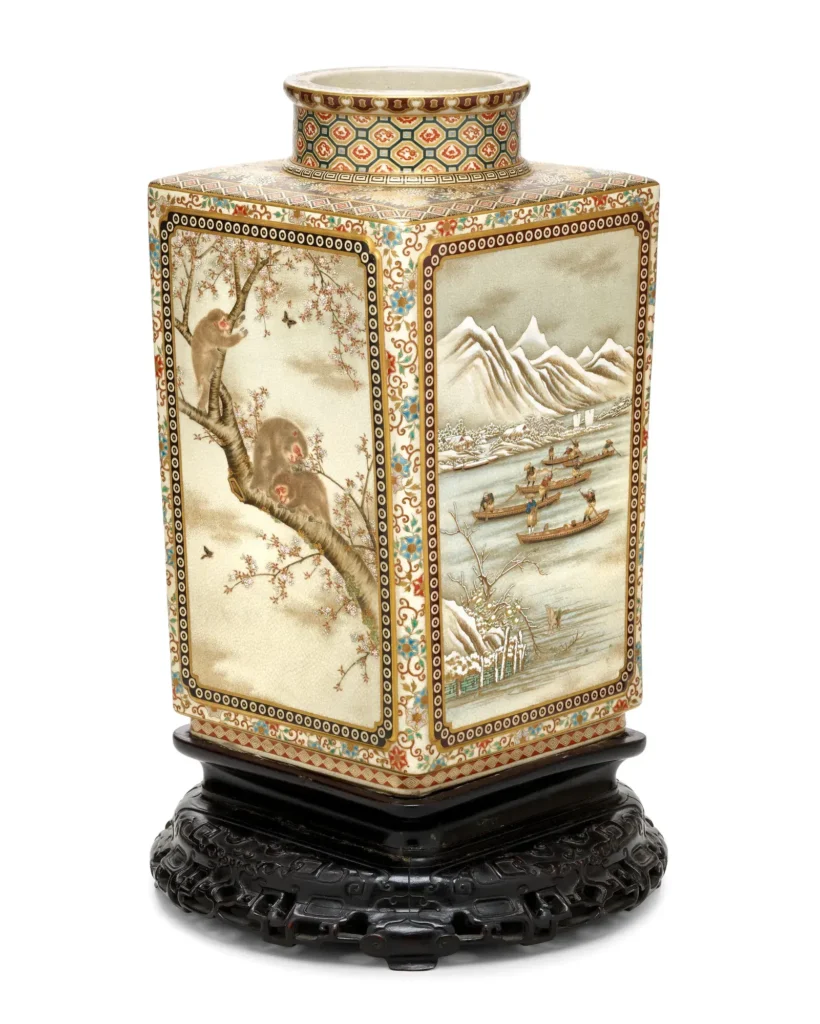
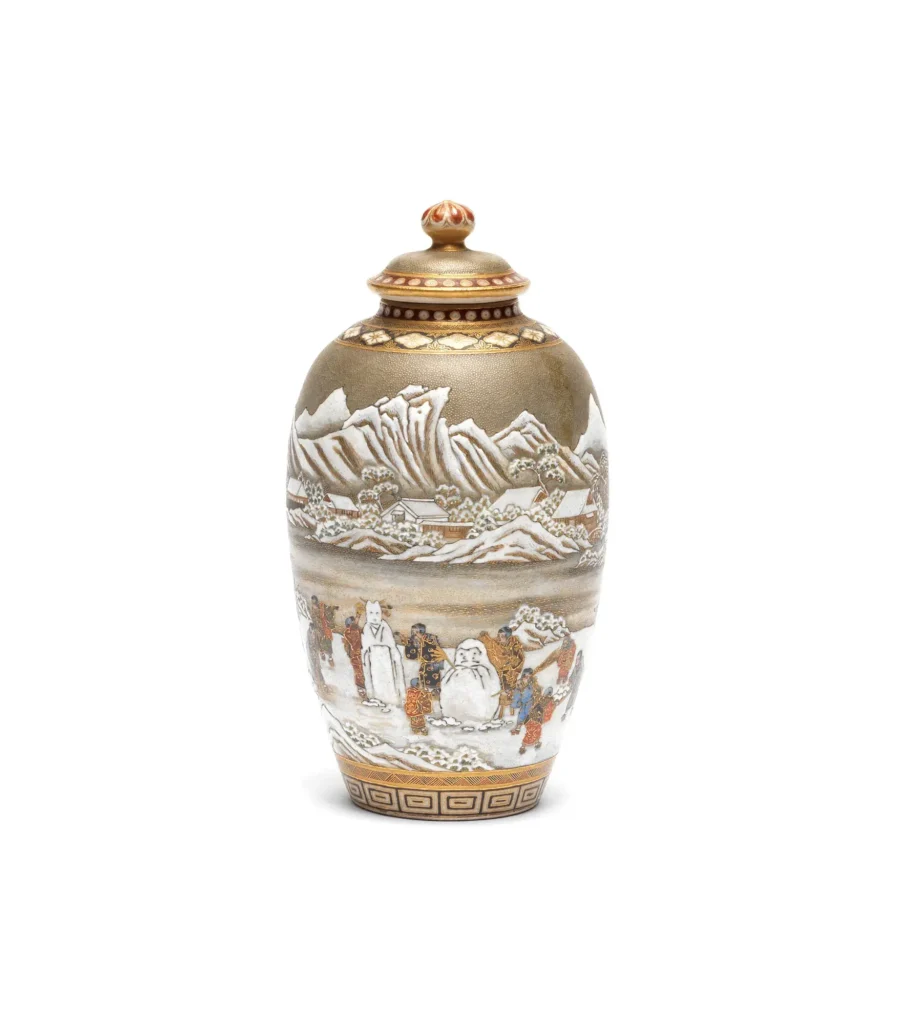
Yabu Meizan was born on 20 January 1853 at Nagahori, Osaka, the son of the painter Yabu Chōsui. In 1880 he studied pottery painting in Tokyo, and in October of that year he opened a workshop for the overglaze decoration of Satsuma ware at Nakanoshima, Osaka.56 The studio did not fire its own bodies. It bought undecorated blanks, first from the Awata kilns of Kyoto and later from Chin Jukan in Kagoshima and from Kinkōzan.5 The two businesses in this essay were therefore connected: a Kyoto pottery could supply the body that an Osaka studio decorated.
The method was distinctive. Designs were engraved on copper plates and printed on paper, and the printed sheets were used to transfer the underdrawing onto each piece before the decorators painted it. Charles Parsons, visiting in 1894–95, recorded “17 men and boys at work, all decorating”.56 The scale was small next to Kinkōzan’s, and the work was minutely detailed.
Bonhams’ cataloguers call Meizan “the most successful of all manufacturers of Satsuma ware”. They record that from 1888 he concentrated on the export market, particularly the United States, and that in the first decade of the twentieth century he focused on the international expositions at Paris (1900), St Louis (1904) and London (1910), visiting each and taking a major organisational role.7 English Wikipedia adds that at St Louis he won a gold medal and served as secretary of the Japan Exhibits Association.6 His subjects moved from Chinese and Buddhist themes towards Japanese ones during the 1890s, and late in his career he sometimes covered whole vessels in a single motif.6
Early collectors
Evidence of how these wares were first received survives in collectors’ catalogues. A small covered jar by Meizan, sold in London in 2014, was listed by Michael Tomkinson in 1898 as “a beautiful example of Meizan’s work in modern Satsuma faïence”; the Tomkinson collection was sold at Glendining’s in 1921–22.8 In America, YabuMeizan.com records that Henry Walters bought at St Louis the bowl now in the Walters Art Museum.5
Other studios, other marks
Kinkōzan and Meizan were not alone. Bonhams catalogues two large pieces sold in 2008 and 2010 as by Ryōzan and records their marks: the Yasuda Company trade mark, the seal Kyoto Tōjiki Gōshigaisha, a Satsuma mon and the signature Ryōzan.910 Such marks name a trading company as well as a decorator, and they show how the Kyoto trade was organised around firms that commissioned and sold the work. A Seikōzan charger sold in 2017 had been exhibited at the Columbia Museum of Art in 2014, a reminder that exhibition histories continue to accrue to these objects long after they left Japan.11
Decline
Meizan’s business declined during the First World War and closed in 1926, when his adopted son Yabu Tsuneo took over the Meizan name. Another workshop used his name and imitated his style.6 Sōbei VII’s death in 1927 or 1928 marks the end of Kinkōzan’s active period.23 Neither Meizan nor any Kinkōzan head was appointed an Imperial Household Artist.12
What the market records
In our database Meizan’s workshop accounts for 17 of the 30 Satsuma results and Kinkōzan for 9. The highest for Meizan is US$205,500 at Bonhams on 2017-09-13; the highest for Kinkōzan is US$56,250 at Bonhams on 2014-09-16.713 These are public historical results for individual objects, not valuations.
Notes
- “Satsuma ware”, English Wikipedia. ↗
- 「錦光山宗兵衛」, Japanese Wikipedia. ↗
- Bonhams, Fine Japanese and Korean Art, 2018-03-21, lot 2207, lot description and footnote. ↗
- Bonhams, Fine Japanese Art, 2014-05-15, lot 445, lot description and footnote. ↗
- YabuMeizan.com, the Yabu Meizan archive. ↗
- “Yabu Meizan”, English Wikipedia. ↗
- Bonhams, Fine Japanese Art, 2017-09-13, lot 1286, lot description and footnote. ↗
- Bonhams, Fine Japanese Art, 2014-05-15, lot 464, lot description and footnote. ↗
- Bonhams, Fine Japanese Art, 2010-11-11, lot 262, lot description and footnote. ↗
- Bonhams, Fine Japanese Art, 2008-11-12, lot 487, lot description and footnote. ↗
- Bonhams, Fine Japanese and Korean art, 2017-03-15, lot 6250, lot description and footnote. ↗
- 「帝室技芸員」, Japanese Wikipedia, appointment table citing the official gazette Kanpō. ↗
- Bonhams, Fine Japanese Works of Art, 2014-09-16, lot 2209, lot description and footnote. ↗