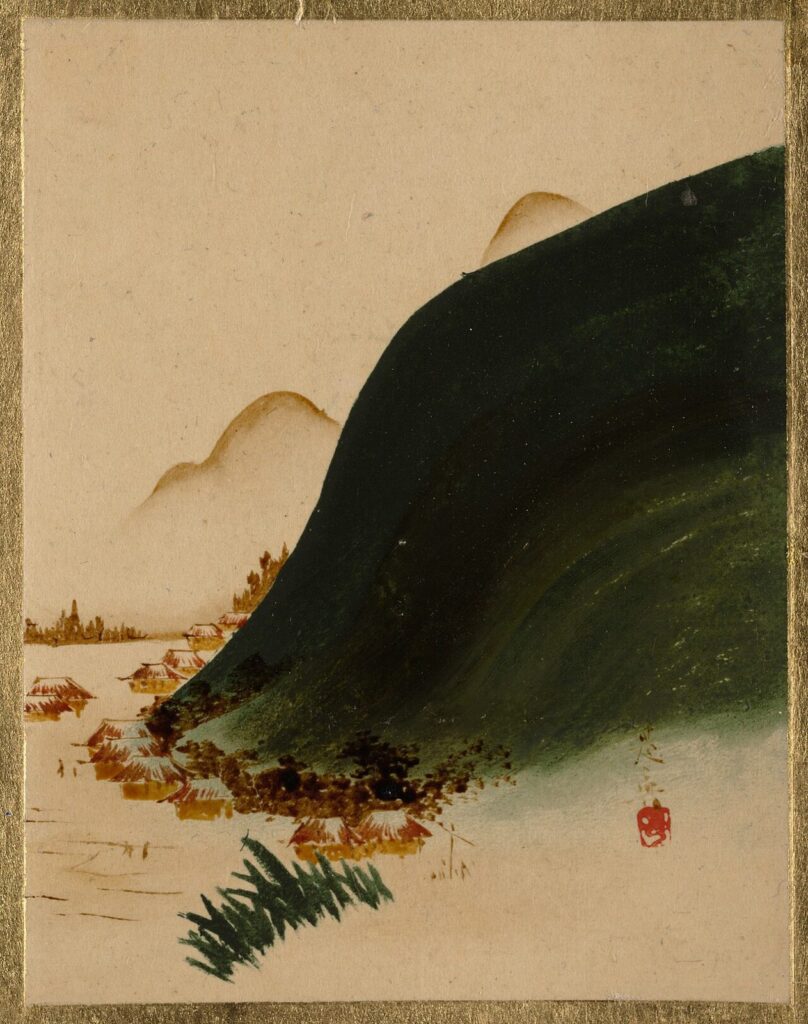
Reference · Metropolitan Museum of Art Shibata Zeshin – Mountains and Houses – 36.100.128 – Metropolitan Museum of Art. Public domain. Source ↗

Biography
Shibata Zeshin was born in Edo on 15 March 1807. His father and grandfather were shrine carpenters and wood carvers, and his father had also studied ukiyo-e painting under Katsukawa Shunshō. At eleven Zeshin was apprenticed to the lacquerer Koma Kansai II. He was then sent to study painting with Suzuki Nanrei of the Shijō school, from whom he received the name Zeshin.1
When Koma Kansai died in 1835, Zeshin inherited the Koma workshop. In the 1830s and 1840s laws limited the use of gold and silver. He responded with other materials, using bronze powder in lacquer to imitate iron. He devised a way of painting in lacquer on paper sized with dōsa, so that urushi-e scrolls could be rolled without flaking. He also revived seigaiha, a wave pattern drawn with a comb through lacquer that is still setting.1
From 1869 he worked on commissions for the Imperial government, including gold-lacquered chairs for the Imperial Palace. He was named Japan’s representative to the expositions at Vienna in 1873, Philadelphia and Paris, although he did not attend them. On 2 October 1890 he was among the first group appointed Imperial Household Artists. The Japanese appointment list records him in lacquer. He died on 13 July 1891.12
Under Nanrei he signed as Reisai and also studied the tea ceremony, haiku and waka poetry, history and philosophy. His fan paintings impressed Utagawa Kuniyoshi, which began a long friendship. Ikeda Taishin became his pupil and remained his close friend until Taishin’s death in 1903. Zeshin’s signatures are restrained and sometimes playful: on one tsuba a lacquer ant carries off the character 真 of his name. The Khalili Collection holds more than a hundred of his works, which were shown at Edinburgh in 1997, and Japan Society, New York, held an exhibition of his lacquer in 2008.1
Interpretation
Our source calls Zeshin “Japan’s greatest lacquerer” and notes that his standing in Japan has been more contested than in the West. Its account of his reputation is interpretation, not documented fact.1
Chronology 年譜
| Date | Event | Source |
|---|---|---|
| 1807 | Born 15 March, Edo. | 1 |
| 1835 | Inherits the Koma workshop. | 1 |
| 1849 | Marries. | 1 |
| 1869 | First Imperial government commissions. | 1 |
| 1873 | Named representative to the Vienna exposition. | 1 |
| 1890 | Appointed Imperial Household Artist (2 October). | 2 |
| 1891 | Dies 13 July. | 1 |
| 1997 | Khalili exhibition of his lacquer, National Museum of Scotland, Edinburgh. | 1 |
| 2008 | The Genius of Japanese Lacquer, Japan Society, New York. | 1 |
Archive records
In museum collections 所蔵作品
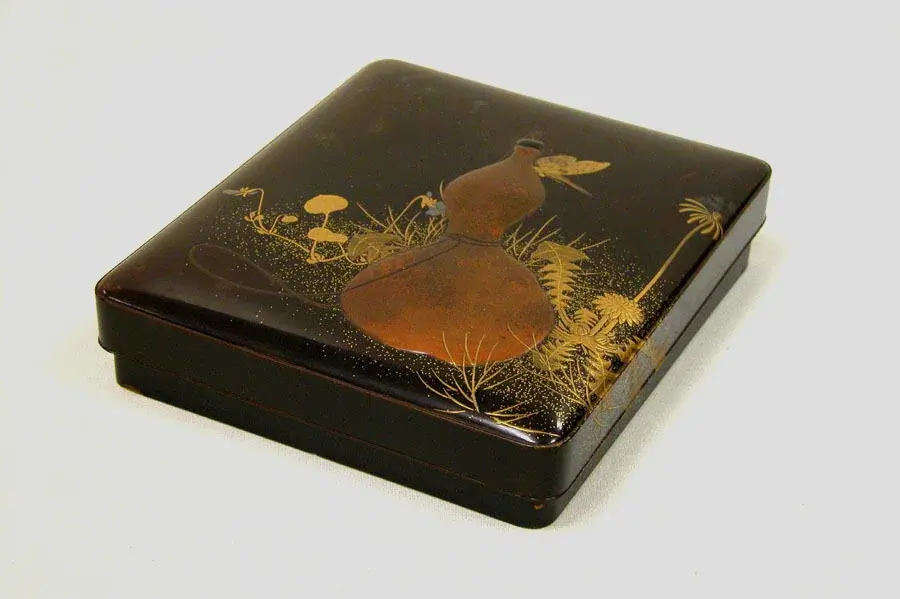
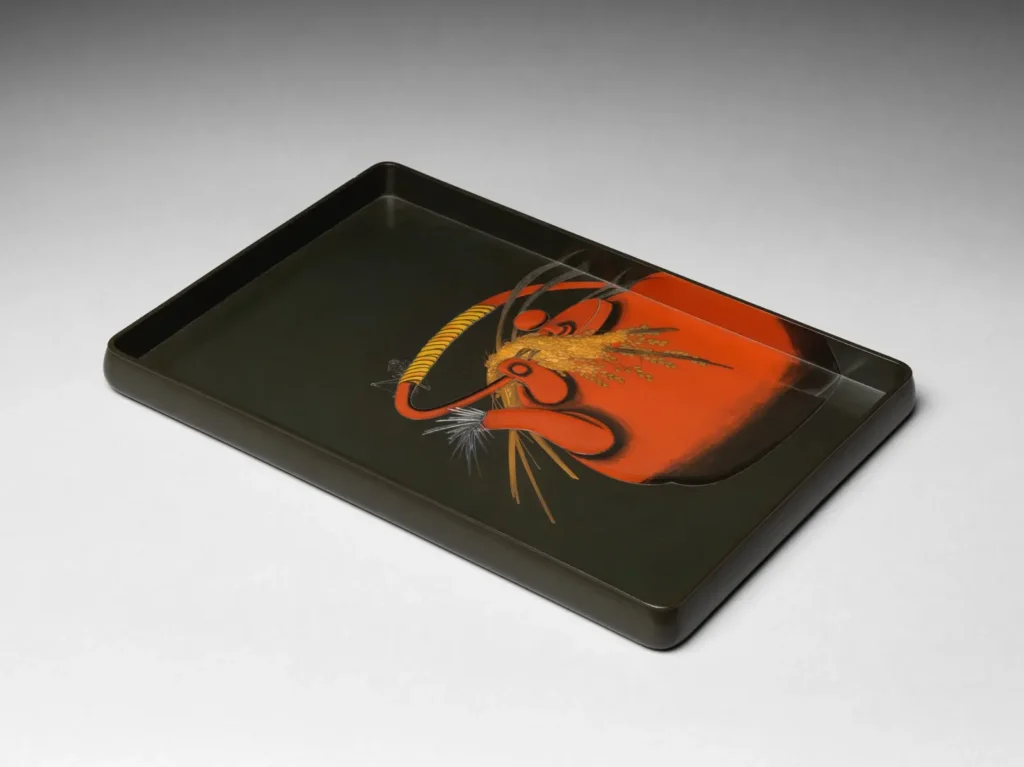
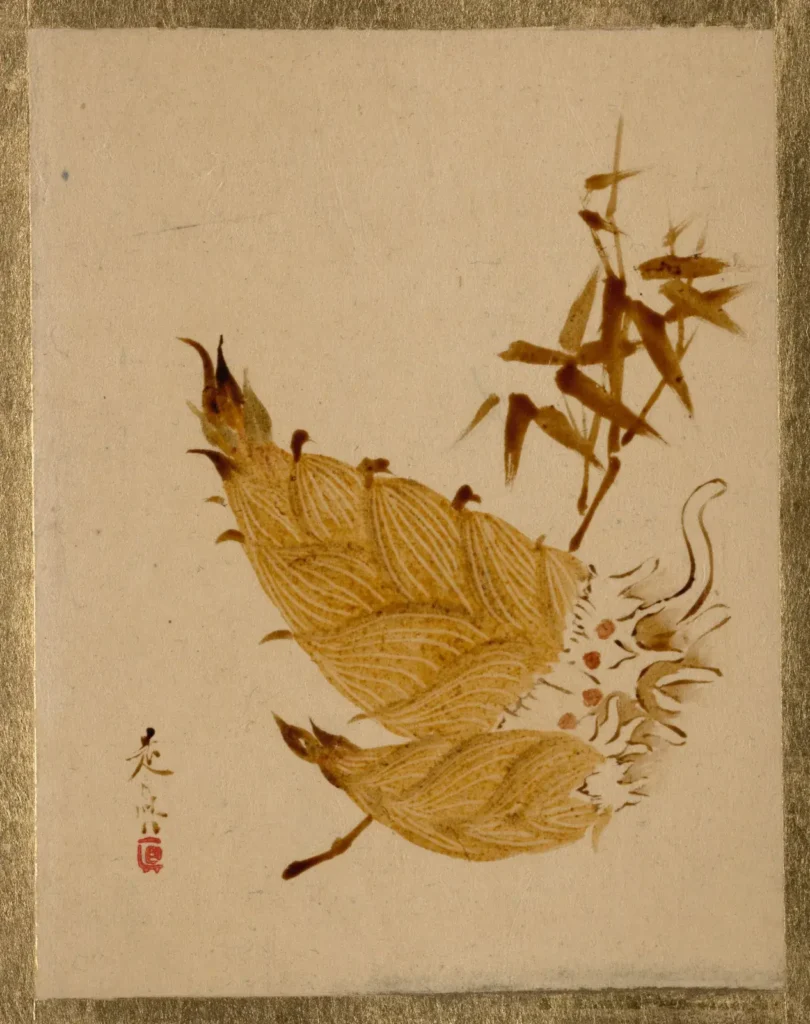
The Metropolitan Museum of Art in New York holds a large group of Zeshin’s work, much of it from the Howard Mansfield Collection, bought with the Rogers Fund in 1936. A search of the Met’s open-access collection for his name returns 124 objects with images.1 Three are shown here, each with its own photograph.
A writing box with a gourd, dated 1886, is in black lacquer with gold and silver hiramaki-e (flat sprinkled design) and applied coloured lacquer.1 A tray of the 1880s, acquired in 2019, shows rice stalks and a grasshopper on a tea kettle in gold, silver, red, yellow and black hiramaki-e and takamaki-e (raised design) on a ground the museum describes as “bronze imitation” (seido-nuri).2 An album leaf, Bamboo Shoots, of about the 1880s, is painted in lacquer on paper.3
Other Met records show the same range: a two-panel screen, Egrets and Crows, in coloured lacquer, white pigment and gold leaf on paper;4 a tiered food box (jūbako) with taro plants and chrysanthemums, dated to the mid-nineteenth century, from the Mary Griggs Burke Collection;5 and the mounting for a short sword whose hilt collar (fuchi) is dated 1849.6
Notes to “In museum collections”
- The Metropolitan Museum of Art, collection search and object record 36.100.142a–j. ↗
- The Met, Tray with rice stalks and a grasshopper on a tea kettle, 2019.107. ↗
- The Met, Bamboo Shoots, 36.100.126. ↗
- The Met, Egrets and Crows, 2011.572.3. ↗
- The Met, Stacked Food Box (Jūbako) with Taro Plants and Chrysanthemums, 2015.300.289a–g. ↗
- The Met, Mounting for a Short Sword (Wakizashi Goshirae), 2011.35. ↗
Public auction results
Public auction results, cited to the auction house record, including buyer’s premium unless stated, in the original currency. They are historical facts, not a valuation of any work offered.
No public auction results for this maker are recorded in our index yet.
Sources
Descriptions record our research and opinion as of 20 October 2026. Works are offered as described. Please see our Terms of Sale.