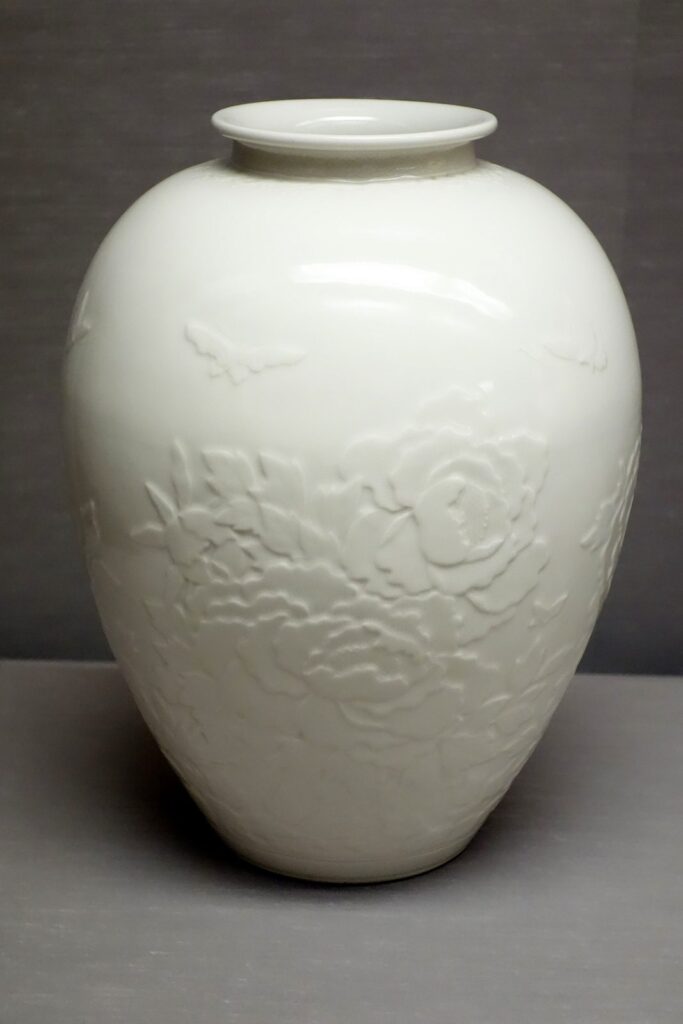
Reference · Tokyo National Museum Vase by Seifu Yohei III (1851-1914), 1892 World's Columbian Exposition, butterfly and peony design in relief – Tokyo National Museum – DSC05575. Public domain (by Daderot ). Source ↗
I · Identification & Maker
Maker: Seifu Yohei III (1851–1914) · kanji not yet sourced
Date / period: 1892
Collection / last record: Tokyo National Museum G-124; Important Cultural Property (designated 15 Sep 2017): museum · Important Cultural Property
II · Technical Masterwork Criteria
Ivory-white porcelain. Six peonies and five butterflies in raised and carved relief, with fine incised veining; shippo-tsunagi borders
Teishitsu Gigeiin: Teishitsu Gigeiin 25 Sep 1893 (en.wikipedia.org · Imperial Household Artist ↗)
Exposition / provenance: World's Columbian Exposition, Chicago 1893, where it was especially well received. During the exposition Seifu became the first potter appointed Teishitsu Gigeiin. Provenance: exposition office, Imperial Museum, TNM
III · Iconography & Cultural Meaning (interpretive)
butterfl: cho, transience, the soul; peony: botan, wealth, summer
Philosophical context (INTERPRETIVE, except the sourced Haitorei fact). The 1876 Haitorei decree banned samurai from wearing swords in public, depriving sword-fitting artisans of their market, so many turned to export art (sourced: antiquesandthearts.com · samurai to the imperial court japanese metalwork ↗). Meiji export pieces often favour dense, virtuosic surface (horror vacui for Western taste), in tension with native ideals of yugen (subtle depth), wabi-sabi (imperfect, transient beauty) and shibui (restrained elegance). The finest makers (Meizan's negative space, Yasuyuki's monochrome grounds, Seifu's celadons) reconcile the two.
IV · Marks 落款 & box
Mark / seal as published: 「大日本 清風造」 incised (base)
Tomobako: n/a
Sources: kunishitei.bunka.go.jp · 00011785 ↗ · online.bunka.go.jp · 530398 ↗
Assessment
See how we score
| Maker stature | 2.5 / 2.5 |
| Recognition (museum / designation / price) | 3 / 3 |
| Exhibition | 1 / 1 |
| Technique (cited) | 1.5 / 1.5 |
| Provenance | 1 / 1 |
| Condition, scale & documentation | 1 / 1 |
| Total | 10 / 10 |
Reasoning: Gigeiin (first potter, appointed during Chicago 1893); ICP 2017; Chicago 1893; documented provenance. How we score.
Maker context
Seifū Yohei III was born Okada Heikichi in 1851 at Ōshio, Harima Province. He was the second son of Okada Ryōhei, a Confucian scholar and bird-and-flower painter. In 1863 he entered the Osaka studio of the literati painter Tanomura Chokunyū. In 1866 he joined the Seifū potting family of Gojōzaka, Kyoto, on marrying the sister of Seifū Yohei II. He studied ceramic painting and taught himself the processes of production.
After Seifū Yohei II died in 1878, and later the young heir, he became head of the family as Seifū Yohei III. He won a bronze prize at Paris in 1889 and a first prize at the third National Industrial Exhibition in 1890. He went on to win a silver medal at Paris in 1900 and a gold medal at the Japan–British Exhibition of 1910.1
Summarised from our maker page, where every fact is footnoted: Seifū Yohei III 清風与平(三代).
Notes to “Maker context”
- SEIFŪ Yohei III, Dictionary of Artists in Japan, Art Platform Japan (Agency for Cultural Affairs) ↗
Related records

Descriptions record our research and opinion as of 20 October 2026. Works are offered as described. Please see our Terms of Sale.