I · Identification & Maker
Maker: Shirayama Shosai (1853–1923), LACQUER · kanji not yet sourced
Date / period: early 20th c.
Collection / last record: Bonhams London 10 May 2011 lot 310 (Wrangham Coll. II): £92,400
II · Technical Masterwork Criteria
Gold, rogin and iroe togidashi, e-nashiji, kirikane; only about 10 Shosai inro known (Dees 2002, per Bonhams)
Teishitsu Gigeiin: Teishitsu Gigeiin 4 Apr 1906 (en.wikipedia.org · Imperial Household Artist ↗; also stated in Bonhams 19295/310)
Exposition / provenance: Ex Swedlow (Sotheby's 1972), Eskenazi 1988; publ. Wrangham Index p.255
III · Iconography & Cultural Meaning (interpretive)
danjuro: Kabuki Shibaraku, aragoto style
Philosophical context (INTERPRETIVE, except the sourced Haitorei fact). The 1876 Haitorei decree banned samurai from wearing swords in public, depriving sword-fitting artisans of their market, so many turned to export art (sourced: antiquesandthearts.com · samurai to the imperial court japanese metalwork ↗). Meiji export pieces often favour dense, virtuosic surface (horror vacui for Western taste), in tension with native ideals of yugen (subtle depth), wabi-sabi (imperfect, transient beauty) and shibui (restrained elegance). The finest makers (Meizan's negative space, Yasuyuki's monochrome grounds, Seifu's celadons) reconcile the two.
IV · Marks 落款 & box
Mark / seal as published: Seal Shosai 松哉
Tomobako: Not stated
Sources: bonhams.com · sale 19295, lot 310 ↗
Assessment
See how we score
| Maker stature | 2.5 / 2.5 |
| Recognition (museum / designation / price) | 3 / 3 |
| Exhibition | 1 / 1 |
| Technique (cited) | 1.5 / 1.5 |
| Provenance | 1 / 1 |
| Condition, scale & documentation | 0.5 / 1 |
| Total | 9.5 / 10 |
Reasoning: Gigeiin; £92,400 (2011); only about 10 Shosai inro known; ex Swedlow, Eskenazi; published Wrangham. How we score.
About the maker
Shirayama Shōsai (1853–1923) was, in the words of the Khalili Collections, one of the leading lacquerers of the Meiji and Taishō periods. He trained first in sword decoration under Notoya Isaburō, then in maki-e under Kobayashi Kōzan, lacquer carving under Gamō Morikazu and lacquer application under Itakura Toyojirō. From 1880 he worked with the Kiryū Kōshō Kaisha; in 1892 he became a professor at the Tokyo School of Fine Arts; and in 1906 he was appointed an Imperial Household Artist.1 The appointment date agrees with the group of 4 April 1906 in the appointment table.2
The Khalili text says he was especially famous for togidashi-e (burnished-down designs) but also excelled at gold hiramaki-e and takamaki-e in a conservative style, and that he won awards at Paris (1900) and St Louis (1904).1
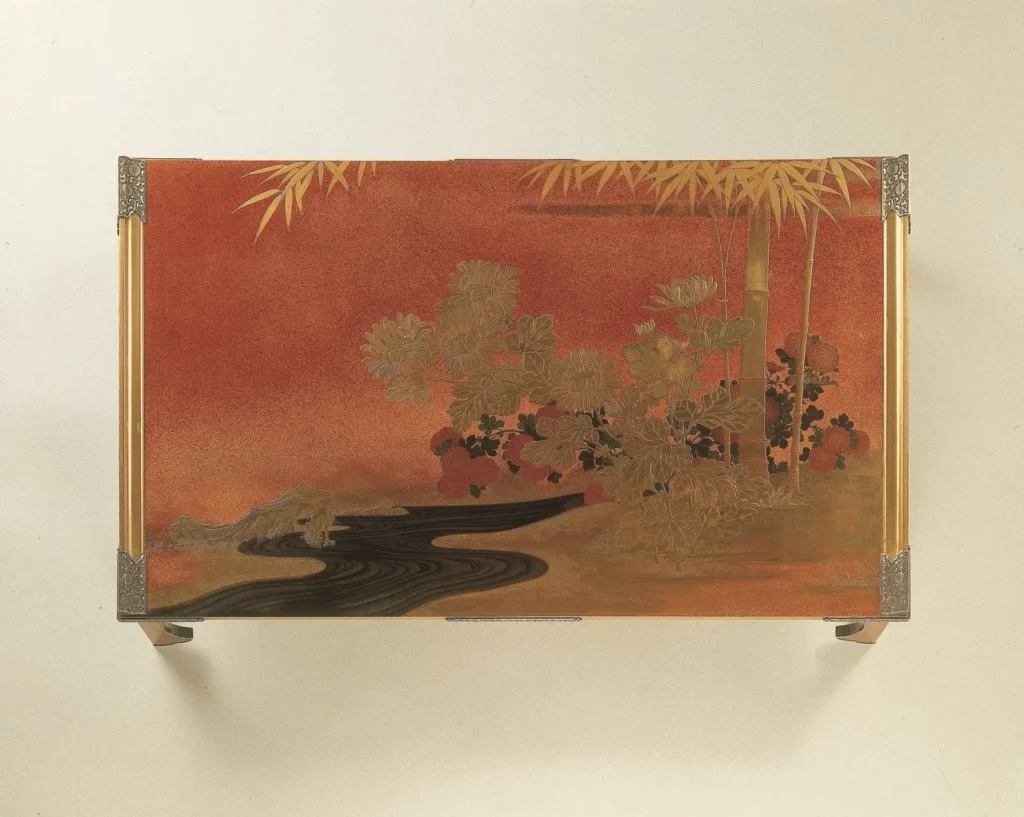

This record has no openly licensed photograph of its own. The image above shows a different work by the same maker and is labelled as such.
Notes to “About the maker”
Related records
Descriptions record our research and opinion as of 20 October 2026. Works are offered as described. Please see our Terms of Sale.