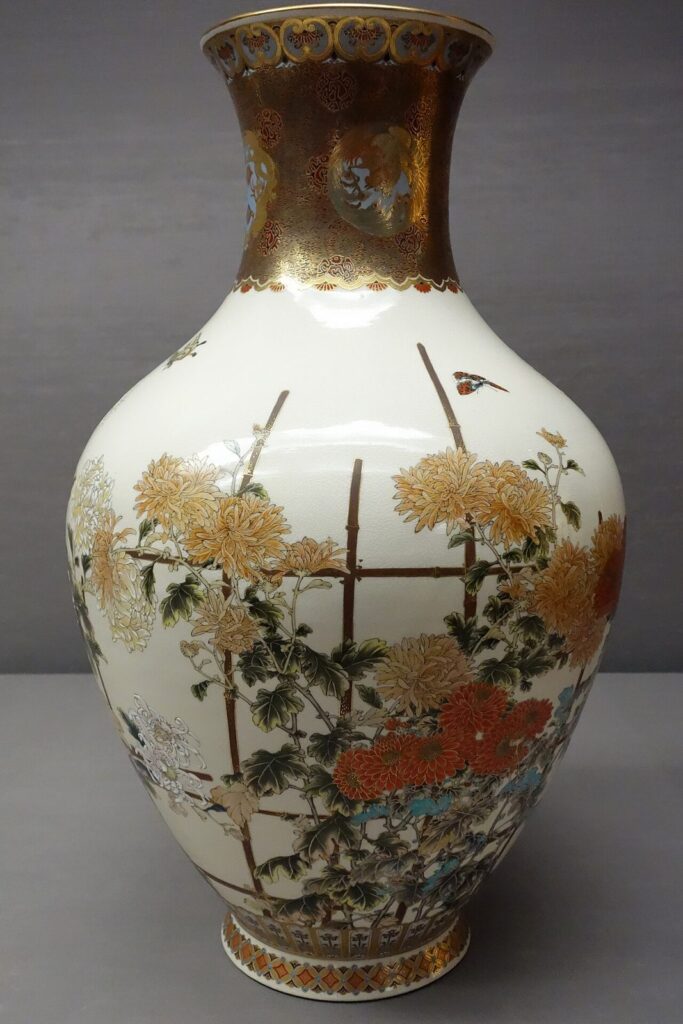
Reference · Tokyo National Museum Large Vase by Taizan Yohei IX (1856-1922), 1892 World's Columbian Exposition, bird and flower design in overglaze enamels and gold – Tokyo National Museum – DSC05571. Public domain. Source ↗
I · Identification & Maker
Maker: Taizan Yohei IX (1856–1922) · kanji not yet sourced
Date / period: 1892
Collection / last record: Tokyo National Museum G-137 (gift of the Chicago exposition office)
II · Technical Masterwork Criteria
Earthenware (陶製); Kyo-Satsuma overglaze enamels and gold (kinrande). Conservation repairs photographed by TNM in 2001–02
Teishitsu Gigeiin: Not on the Gigeiin list checked (en.wikipedia.org · Imperial Household Artist ↗)
Exposition / provenance: World's Columbian Exposition, Chicago 1893; presented to the museum by the exposition office
III · Iconography & Cultural Meaning (interpretive)
No motif decoded (subject not specific in source)
Philosophical context (INTERPRETIVE, except the sourced Haitorei fact). The 1876 Haitorei decree banned samurai from wearing swords in public, depriving sword-fitting artisans of their market, so many turned to export art (sourced: antiquesandthearts.com · samurai to the imperial court japanese metalwork ↗). Meiji export pieces often favour dense, virtuosic surface (horror vacui for Western taste), in tension with native ideals of yugen (subtle depth), wabi-sabi (imperfect, transient beauty) and shibui (restrained elegance). The finest makers (Meizan's negative space, Yasuyuki's monochrome grounds, Seifu's celadons) reconcile the two.
IV · Marks 落款 & box
Mark / seal as published: 「大日本帯山製」 in gold (base)
Tomobako: n/a
Sources: colbase.nich.go.jp · G 137 ↗ · online.bunka.go.jp · 465167 ↗ · webarchives.tnm.jp · C0065481 ↗ · commons.wikimedia.org · File:Large Vase by Taizan Yohei IX (1856 1922), ↗
Assessment
See how we score
| Maker stature | 1.5 / 2.5 |
| Recognition (museum / designation / price) | 2.5 / 3 |
| Exhibition | 1 / 1 |
| Technique (cited) | 1 / 1.5 |
| Provenance | 1 / 1 |
| Condition, scale & documentation | 1 / 1 |
| Total | 8 / 10 |
Reasoning: TNM G-137; Chicago 1893, gift of the exposition office; large (60.6 cm); official record and gold mark. Taizan is not Gigeiin, the technique is described but not as exceptional, and TNM records conservation repairs: 8.0. How we score.
Maker context
Taizan Yohei IX (1856–1922), whose family name was Takahashi, was the ninth and last head of the Taizan line of Awata potters in Kyoto. English Wikipedia lists him among the leading Satsuma makers of the Meiji and Taishō periods.
Citing Gisela Jahn, satsuma-database.com says he was a younger brother of Kiyomizu Rokubei IV and was adopted into the Taizan family after the death of Taizan VII in 1875. It also says he turned the family pottery into a large Satsuma factory exporting to America, that the kiln appears to have closed around 1894, and that he later decorated blanks from Kinkōzan and others. A Kinkōzan family source records that Kinkōzan VI and Taizan VIII visited foreign merchant houses in Kobe in 1872.123
Summarised from our maker page, where every fact is footnoted: Taizan Yohei IX 帯山与兵衛(九代).
Edward S. Morse’s Boston catalogue traces the Taizan family to Takahashi Tokurō, who built a kiln at Awata in 1673, records that the name Yohei was kept from the second generation on, and notes Ninagawa’s statement that the mark Taizan was first used in 1760.4
Notes to “Maker context”
- Satsuma ware, English Wikipedia ↗
- Taizan Yohei, satsuma-database.com (citing Gisela Jahn, Meiji Ceramics) ↗
- "Taizan Yohei" collector and Kinkozan, Kinkōzan Kazuo blog ↗
- Edward S. Morse, Catalogue of the Morse Collection of Japanese Pottery, Museum of Fine Arts, Boston, entry “Taizan” (Case 27), online facsimile p. 352. ↗
Related records

Descriptions record our research and opinion as of 20 October 2026. Works are offered as described. Please see our Terms of Sale.